Ayra Starr enters her “Starr Girl” era not with subtlety, but with the kind of visual force that reminds you pop stardom is as much about image-making as it is about music. Suspended against a pitch-black backdrop and interrupted only by a razor-sharp beam of violet light, the Nigerian star appears less like a recording artist unveiling a project and more like a myth being introduced in real time.
The centerpiece is a pale blush latex mini dress sculpted with near-couture precision. Strapless and corseted through the bodice, the silhouette hugs the body with a liquid sheen that feels futuristic, almost unreal beneath the studio lighting. Latex has been steadily reclaiming space on the runway—from Mugler to Alaïa—but on Ayra Starr, it loses any trace of costume and becomes pure performance. The shine, the structure, the unapologetic sensuality of it all speaks to fashion’s renewed obsession with clothing that does not whisper for attention, but commands it outright.
What keeps the look elevated rather than overt is the styling. Crystal-embellished opera gloves stretch dramatically past the elbows, catching flashes of violet light and scattering them across her skin like tiny constellations. The effect is celestial without becoming predictable—a literal interpretation of “Starr Girl,” yes, but executed with restraint. A delicate silver pendant necklace rests quietly at her collarbone, offering the only softness in an otherwise high-impact composition.
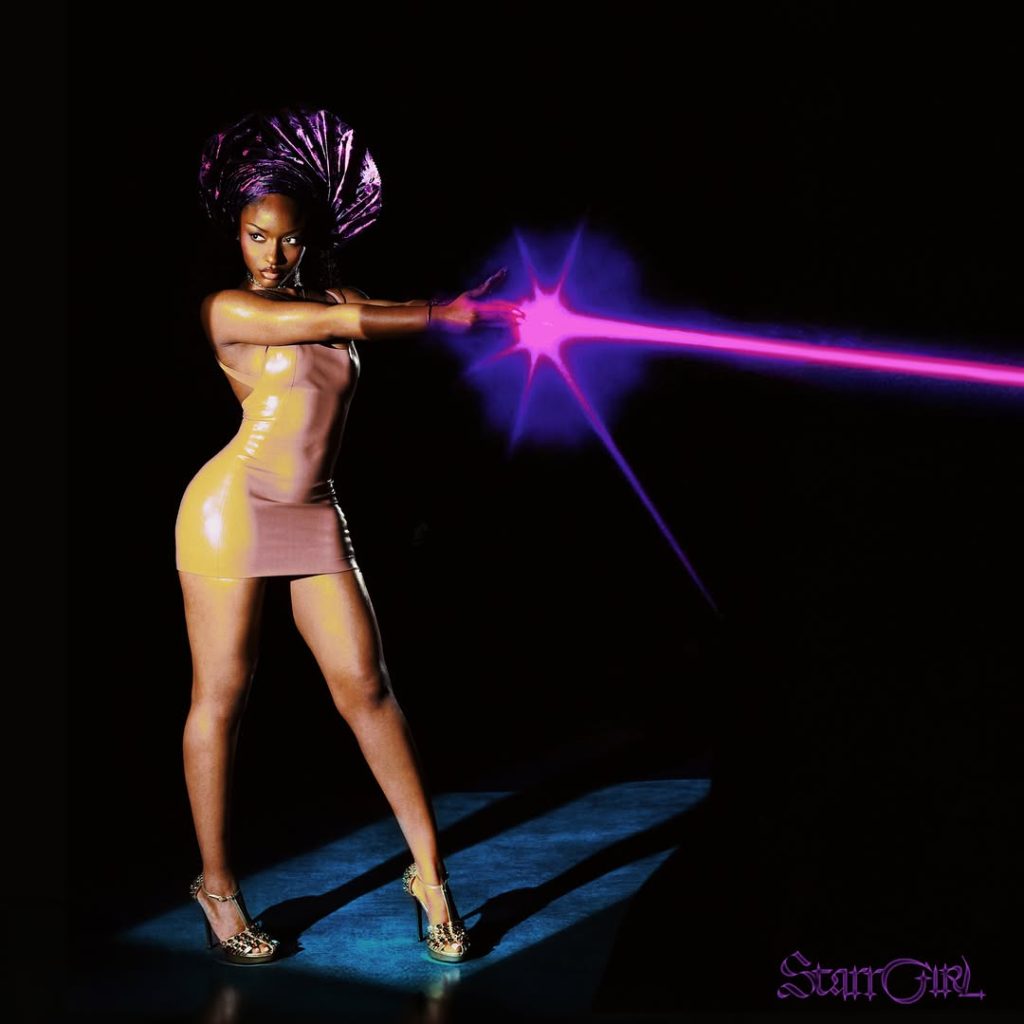
Then come the shoes: towering crystal-encrusted platform sandals that transform the entire image from portrait into spectacle. Their sculptural height elongates the silhouette impossibly, while the glittering embellishment mirrors the reflective quality of the latex. It is glam rock by way of futuristic pop fantasy, and Ayra understands exactly how to balance excess with control.
Her hair adds another layer of drama. Intricately braided cornrows sweep backward with architectural precision before erupting into a textured topknot of voluminous coils. The contrast between sleekness and movement gives the beauty look its edge. It feels intentional, directional, and unmistakably star-worthy—the kind of hair that does not merely complement a look, but completes its narrative.
The makeup follows the same philosophy. Defined eyes, glowing skin, glossy nude lips: polished without distraction. Nothing competes with the clothing or the lighting. Instead, her beauty look acts almost like framing, sharpening the image without overwhelming it.
And the image itself is striking in its restraint. No elaborate set design. No props. No excessive visual clutter. Just darkness, light, and presence. The single violet beam slicing through the frame feels symbolic—as though Ayra Starr is stepping into a new dimension of visibility, one entirely of her own creation.
What makes this moment resonate beyond aesthetics is timing. Over the past few years, Ayra Starr has evolved from rising Afropop talent into one of the defining young stars of African music, building a visual identity as compelling as her sound. Whether in body-conscious latex, Y2K-inspired styling, or high-fashion editorial glamour, she has consistently approached fashion not as an accessory to fame, but as part of the performance itself.
There are echoes of Rihanna in the fearlessness, certainly—the understanding that style can be world-building. But Ayra Starr’s greatest strength is that she never feels derivative. Her references are filtered through her own lens: softer, sharper, distinctly Gen Z, and deeply rooted in the kind of confidence that cannot be manufactured by trend cycles alone.
The “Starr Girl” era, then, feels less like an album rollout and more like the crystallization of an identity. Latex, crystals, violet light, impossible platforms—it all works toward the same conclusion. Ayra Starr is no longer arriving. She has arrived.