The most compelling fashion statement at a performance is sometimes the decision not to make one. When Ayra Starr stepped onto the NPR Tiny Desk stage, she arrived without the usual language of pop spectacle—the towering heels, the dramatic silhouettes, the deliberate visual distractions. Instead, she embraced something far more difficult: simplicity. The result was a performance that felt less like a reinvention and more like a revelation, allowing her artistry to occupy the foreground with striking clarity.
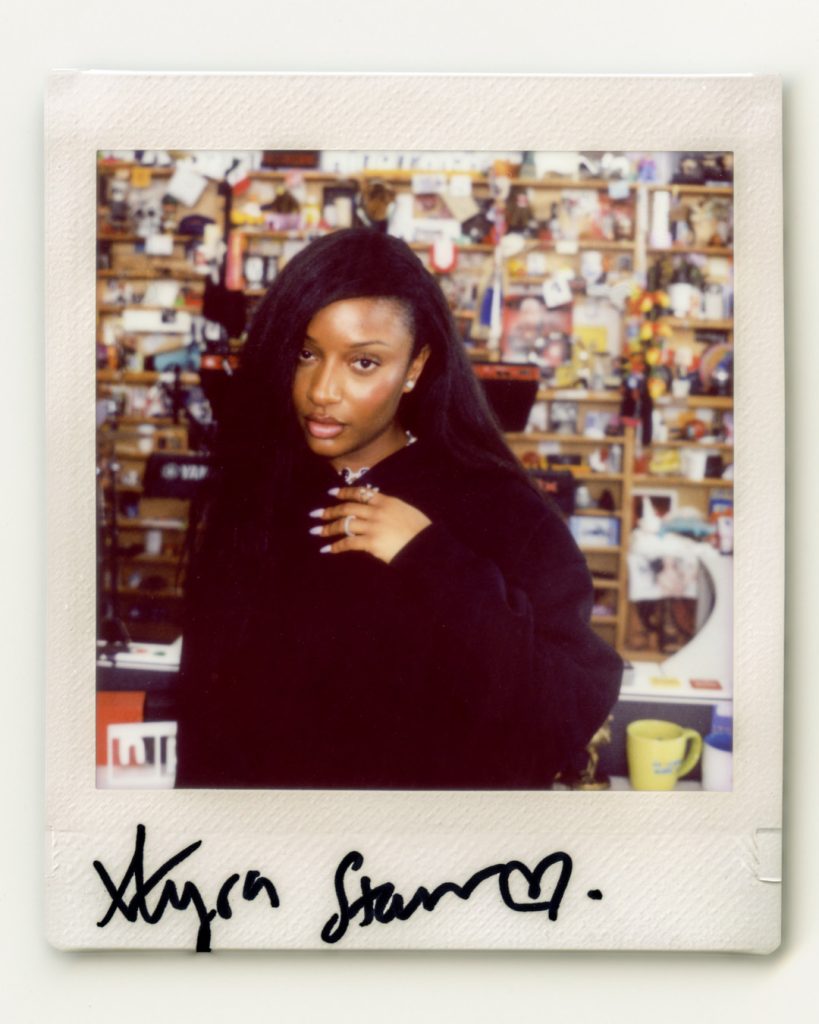
The setting is legendary: that cramped corner of the NPR office, the desk cluttered with the detritus of a working newsroom, the audience close enough to count the beads of sweat on a performer’s upper lip. It is a space that has humbled legends and anointed newcomers, where the absence of production design forces the artist to generate their own weather. Starr arrived in a simple black sweatsuit—hoodie, joggers, nothing more. No statement jewellery. No sculptural silhouette. Just a young woman in soft cotton, her hair pulled back, her face bare of the full glam that has become her red-carpet signature.
And carry it did. From the opening notes of “Birds Sing of Money,” Starr established the evening’s thesis: this would not be a reproduction of her recorded catalogue, but a reimagining. Backed by a live band whose precision never crowded her phrasing, she moved through fan favourites with the ease of someone who has internalised these songs to the point of muscle memory. “Gimme Dat” became looser, more conversational. “Who’s Dat Girl” acquired a bluesy undertow that the studio version only hinted at. “Rush” and “Commas”—the global hits that have soundtracked countless dance floors—were slowed, stretched, allowed to breathe in ways that revealed new melodic chambers within their familiar structures.
The surprise came midway: the live debut of “Tornado,” a previously unreleased track from her forthcoming album Starrgirl. The song—built on a spiralling vocal melody that seems to climb and descend simultaneously—suggested a new register for Starr, one more introspective than her club-oriented singles but no less commanding. If “Rush” is about velocity, “Tornado” is about the stillness at the centre of chaos. She performed it with her eyes closed, one hand resting on the microphone stand, the other gesturing in small, private arcs. The desk, the band, the audience—all of it seemed to recede until only the song remained.
But it was the closing sequence that transformed the concert from impressive to unforgettable. Performing “Amin” and “Orun” back-to-back, Starr leaned into a register of vulnerability that her more uptempo material rarely accesses. “Amin”—a prayer of gratitude wrapped in melody—was delivered with a tremor in her voice that may have been technique or may have been genuine emotion, the distinction ultimately irrelevant. “Orun,” with its invocation of celestial guidance, became a full-circle moment: the girl who had dreamed of this desk since she was fourteen, now standing behind it, offering thanks for the journey in a language that needed no translation.
The signed Polaroid that emerged from the session—Starr in her black hoodie, grinning, her signature scrawled across the bottom—will become a collector’s item not because of its rarity, but because of what it captures: an artist at the precise moment she realises she has arrived exactly where she intended to be. The sweatsuit, in retrospect, was the perfect costume for this revelation. It allowed her to be present without performing presence, to be witnessed without constructing a persona for witnessing.
What Starr understands—and what this Tiny Desk debut demonstrates with quiet force—is that glamour is not a constant state but a vocabulary. Sometimes it speaks in mini skirts and stilettos. Sometimes it whispers in black cotton and bare feet. The artist who commands both registers is the artist who will endure. At twenty-two, Ayra Starr has already proven herself fluent in every dialect.