The Kai Collective founder reimagines traditional wedding attire through a lens of corseted glamour and architectural headwraps
When Fisayo Longe, the visionary behind Kai Collective, stepped into her wedding weekend celebrations, she brought with her a fashion philosophy that has defined her brand: the seamless fusion of West African heritage and contemporary Western silhouette, the transformation of tradition into personal statement. Alongside her partner, whose own attire speaks the complementary language of Nigerian masculine formalwear, Longe demonstrates that the modern bride need not choose between cultural authenticity and fashion-forward innovation—she can command both simultaneously.
READ MORE: Fisayo Longe Makes A Bold Statement For Spring
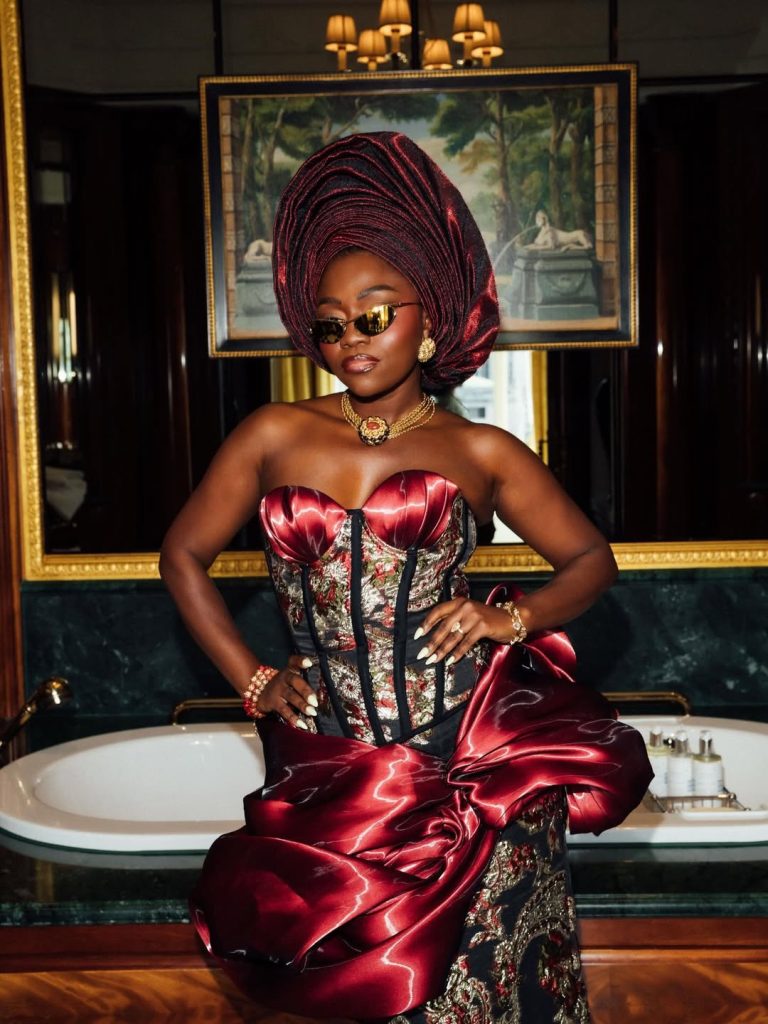
The look—captured in two distinct settings, each amplifying different aspects of its complexity—centers on a corset that reimagines the traditional Nigerian blouse through the technical precision of couture construction. The bodice, rendered in liquid crimson satin with black boning visible as both structural necessity and decorative element, cinches the waist to proportions that reference Victorian fetishism while remaining firmly rooted in West African aesthetics. The sweetheart neckline, dramatic and sculptural, creates a frame for décolletage that is simultaneously revealing and armored, suggesting that vulnerability and strength can coexist in the same garment.
Below the corset, the ensemble diverges from convention with intentional audacity. Rather than the expected wrapper or skirt, Longe wears trousers—relaxed, patterned in brocade that echoes the corset’s own floral motifs, cuffed at the ankle to reveal gold sandals that catch light with each movement. This is bridal wear that acknowledges the realities of celebration: the need to move, to dance, to navigate spaces without the encumbrance of trailing fabric. The trousers speak of modernity and mobility, of a bride who intends to participate fully in her own festivities rather than merely pose within them.
The headwrap—gele in Yoruba tradition—rises as the look’s crowning architecture, a spiraling construction of matching crimson and black fabric that extends upward and outward, transforming the head into a monument. Its height and volume create a silhouette that competes with the grandeur of European court dress, yet its technique and symbolism remain entirely Nigerian. This is not assimilation but amplification, the traditional form elevated to contemporary art.
Her partner’s attire completes the visual dialogue. His agbada—the wide-sleeved robe that signifies status and celebration—arrives in the same crimson register, creating a coordinated palette that suggests unity without uniformity. The embroidery at his chest, dense and golden, echoes the brocade patterns of Longe’s trousers, while coral beads—ileke, traditional signifiers of royalty and occasion—drape his neck in graduated strands. His fila, the Yoruba cap, matches the gele’s fabric and color, creating a harmony of head and hierarchy.
In the second frame, Longe appears alone, the setting shifted to a bathroom of marble and gilt, the atmosphere more intimate yet no less theatrical. Here, she adds sunglasses—an unexpected, almost irreverent gesture that transforms bridal sweetness into editorial attitude. The gold jewelry—necklace, earrings, bracelets—accumulates with the generosity of celebration, each piece catching light and returning it transformed. Her posture, hands on hips, suggests confidence without performance, the ease of someone who has spent years understanding her own aesthetic power.
What emerges from this assemblage is a blueprint for the contemporary Nigerian bride who exists between cultures, between traditions, between the expectations of family and the desires of self. Longe’s look does not reject the past; it reinterprets it, demonstrating that the gele can coexist with the corset, that the wrapper can be replaced by trousers, that the bride can be both respectful of heritage and hungry for innovation.
The setting reinforces this narrative of cultural fluency. In one frame, the couple stands before a European portrait in a gilded frame, the white paneled walls suggesting London or Paris, the carpet beneath their feet speaking of colonial accumulation. In the other, Longe occupies a space of marble and brass fixtures, the bathroom as sanctuary and stage. These are not Nigerian interiors, yet the clothing transforms them, claims them, demonstrates that Nigerian elegance travels, translates, triumphs in any context.
This is Fisayo Longe’s particular gift: the ability to build a brand and a life that refuse the either/or propositions of cultural identity. Her wedding attire, like her designs for Kai Collective, suggests that the future of global fashion will be written by those who understand that tradition is not preservation but conversation, that the past is most honored when it is most boldly reimagined.