From Davido’s flag-waving triumph to Bieber’s Naija collaborations, Nigerian sound dominated Indio’s Empire Polo Club
The desert wind carried something different this April. Beneath the palm silhouettes and neon installations of Coachella 2026, the dominant frequency wasn’t guitar distortion or EDM drops—it was the pulsating, polyrhythmic heartbeat of Lagos.
Davido, the Afrobeats titan whose influence now spans continents like fiber optic cable, transformed the Gobi Stage into a sovereign Nigerian territory on April 11. This was not merely a performance; it was cultural diplomacy delivered at 128 beats per minute.
READ MORE: Tems is A Study in Noir Elegance at Coachella
The man arrived in white—an intentional choice, pure and commanding against the midnight backdrop. His 45-minute sermon moved through sixteen tracks with the narrative precision of a seasoned auteur. Skelewu—that 2013 viral phenomenon—still possessed its gravitational pull, bending the crowd toward collective muscle memory. If and Fall, those streaming behemoths that broke Billboard’s glass ceiling for African pop, arrived not as nostalgia but as living documents of a genre’s global conquest.
But Davido understands that legacy requires evolution. Material from 5IVE, his 2025 magnum opus, demonstrated an artist refusing to rest on catalog laurels. UNAVAILABLE—with its staccato percussion and earworm defiance—proved that Afrobeats’ current moment remains as vital as its history.
The surprise appearance of Adekunle Gold for HIGH provided the set’s emotional crescendo. Two Nigerian voices, braided in harmony, representing different eras of the country’s sonic export—Gold’s alté sensibilities meeting Davido’s mainstream dominion. Their chemistry suggested not competition but continuity, a genre healthy enough to contain multitudes.
Then: the flag. Green and white fabric catching stage lights, held aloft during With You‘s closing moments. The gesture—seemingly spontaneous, deeply calculated—transformed performance into proclamation. When Davido interpolated Michael Jackson’s Thriller as his exit music, the statement became architectural: Nigerian pop acknowledging its American influences while confidently occupying center stage.
The Bieber Variations: A Naija Night
If Davido represented Afrobeats’ autonomous power, Justin Bieber’s headline set illustrated its permeability. The Canadian star—returning after four years of health-imposed silence—curated his nostalgia tour with Nigerian accents.
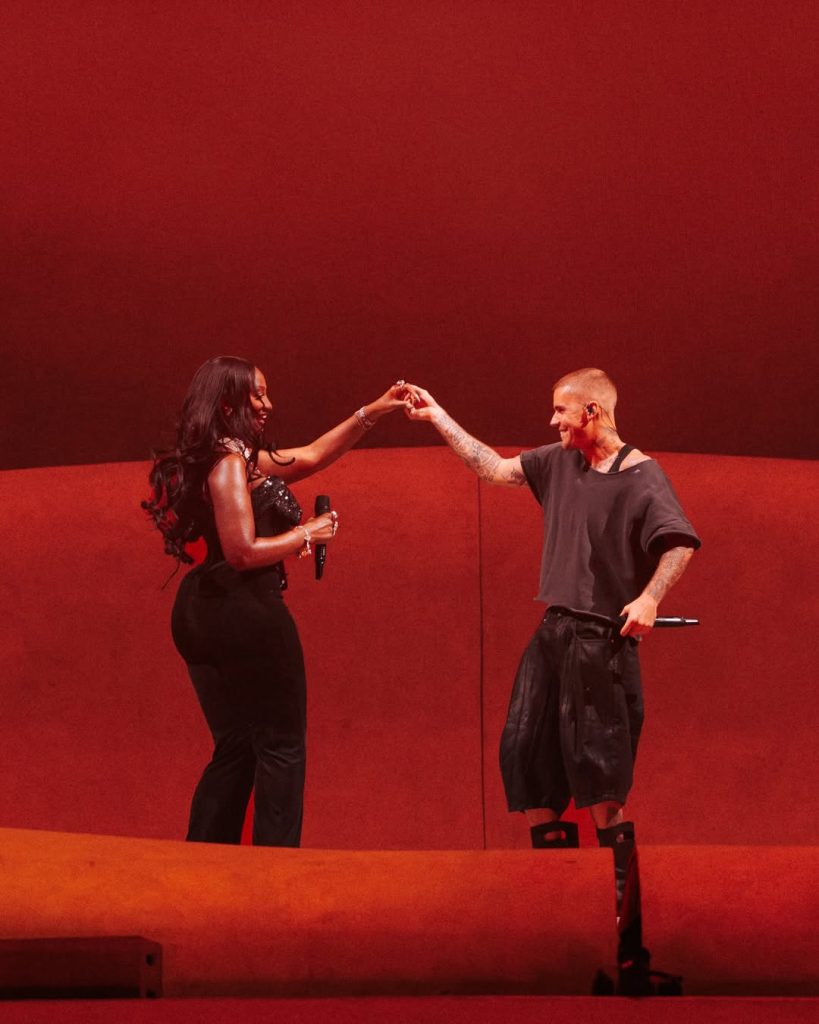
Wizkid, the genre’s quiet revolutionary, materialized like smoke. Dressed in leather and shades despite the desert heat, he brought the effortless cool that has defined his decade-long reign. Beside him, Tems—she of the pearl-draped noir glamour detailed in these pages—offered visual and vocal counterpoint. Her black sequined corset and layered neckpieces suggested Old Hollywood via Lagos, a aesthetic statement as considered as her Grammy-winning penmanship.
Their collaboration on Essence—that song which soundtracked pandemic summers and wedding receptions alike—felt less like feature and more like coronation. Bieber, notably, receded, understanding that certain moments require the spotlight to decentralize.
The Ecosystem Beyond
Coachella 2026’s Afrobeats narrative extended beyond Nigerian borders. Burna Boy, the self-styled African Giant, reportedly held court at an exclusive afterparty, his presence felt even in absence from the official lineup. Rema‘s influence lingered in the festival’s visual language—those Calm Down reds and chromatic purples appeared on countless fan outfits, a decentralized tribute to Benin City’s prodigal son.
The Sahara Tent, traditionally reserved for electronic music’s four-on-the-floor monotony, hosted Amaarae—the Ghanaian-American polymath whose Fountain Baby album redefined avant-pop’s relationship with African rhythm. Her set, occurring simultaneously with Davido’s Gobi Stage takeover, created a temporal collision: two interpretations of West African futurism, separated by half a mile of desert dust.
Even the festival’s fashion economy participated. Vendor stalls reported depleted stocks of Aso Oke fabrics, beaded coral jewelry, and tailored agbadas—traditional Nigerian formalwear repurposed for Coachella’s casual maximalism. The desert’s signature crochet and fringe found itself in conversation with West African textile traditions.
The Cultural Arithmetic
What occurred at Empire Polo Club this April was not merely programming diversity but demographic inevitability. Afrobeats has spent a decade climbing Spotify’s Global Top 50, soundtracking TikTok virality, and infiltrating Western pop’s production grammar. Coachella 2026 simply acknowledged what streaming data had already proven: that the center of popular music has shifted, that Lagos operates on equal footing with Los Angeles.
Davido’s flag-waving, captured in thousands of iPhone videos now circulating across platforms, will become the festival’s defining image—more resonant than any headliner’s pyrotechnics. It represents a genre that no longer requests invitation to global stages but commands them, that transforms festival slots into sovereign territory.
The desert, for one weekend, belonged to Nigeria.