The Nigerian couturier orchestrates a symphony of structure, mythology, and unapologetic grandeur
In the rarefied atmosphere of global couture, where heritage houses trade on century-old archives and established codes, Weiz Dhurm Franklyn arrives as a disruptive composer—conducting not with baton but with needle, not with orchestra but with the human form itself. The designer’s Spring Summer 2026 collection, titled Melodies in a Feather, does not whisper its ambitions. It declares them through twelve looks that read as visual arias, each garment a crescendo of technical bravura and cultural storytelling.
The collection operates in the space between avian mythology and architectural engineering, between the lightness of flight and the weight of craftsmanship. Dhurm Franklyn has built a reputation for silhouettes that defy the body’s natural boundaries, and this season pushes that investigation into territory that feels simultaneously primordial and futuristic—couture for a civilization that has not yet arrived but whose dress codes the designer is already inventing.
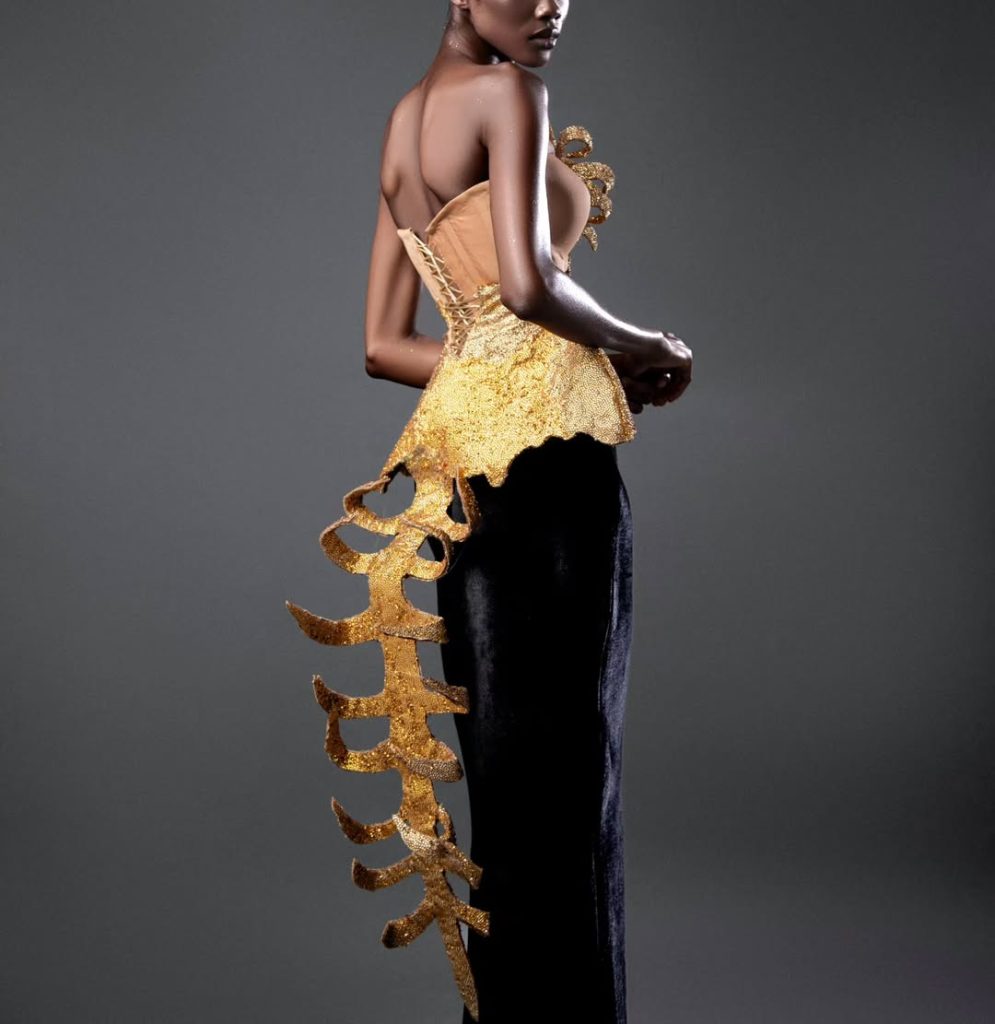
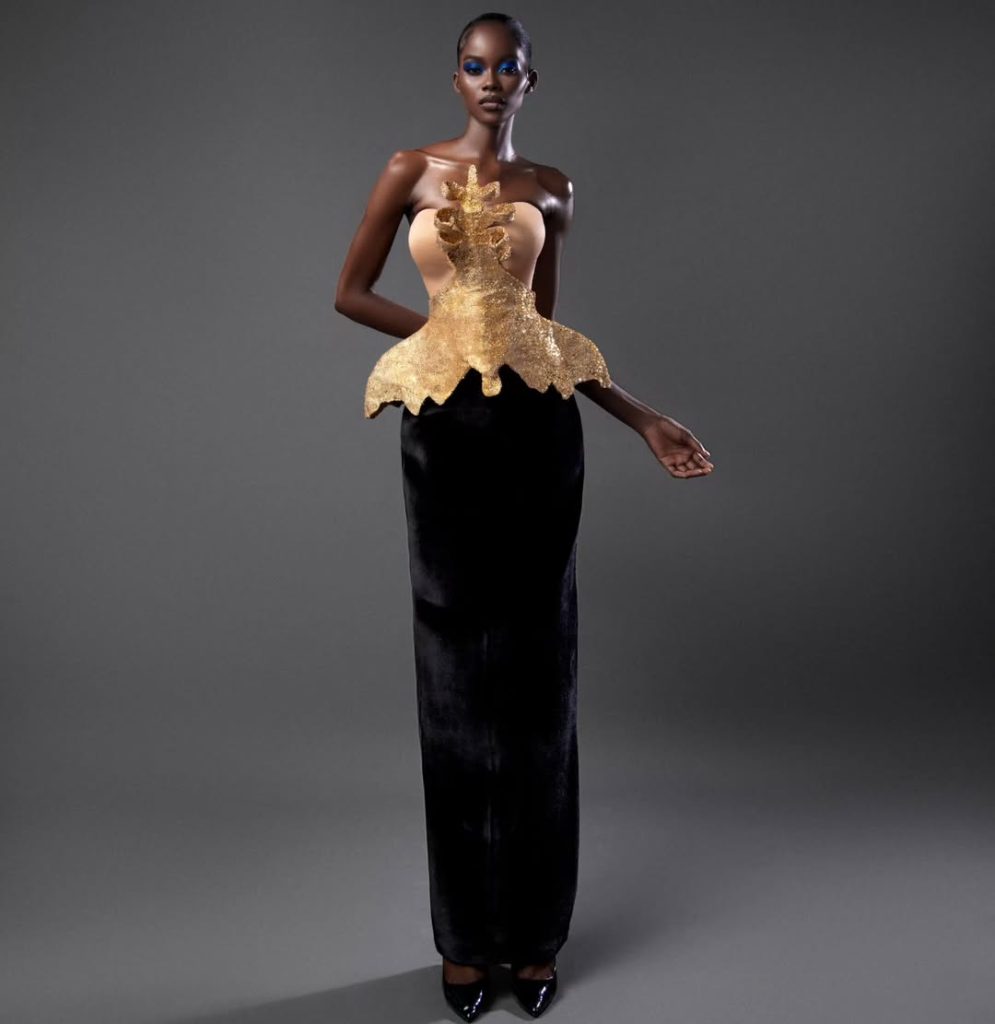
The opening look establishes the collection’s central dialectic: constraint and eruption. A strapless corset in liquid gold—beaded so densely it reads as molten metal rather than fabric—cinches the torso into an exaggerated hourglass that references both Victorian fetishism and West African sculptural traditions. The peplum flares with jagged, organic edges, as if the garment has grown rather than been constructed, while cascading from the waist is a tail of interlocking gold forms that suggest vertebrae, armor, or the skeletal structure of some mythological creature. Below, a column of black velvet provides the necessary visual silence, allowing the gold’s percussion to resonate fully. This is not a dress that accommodates movement; it commands it.
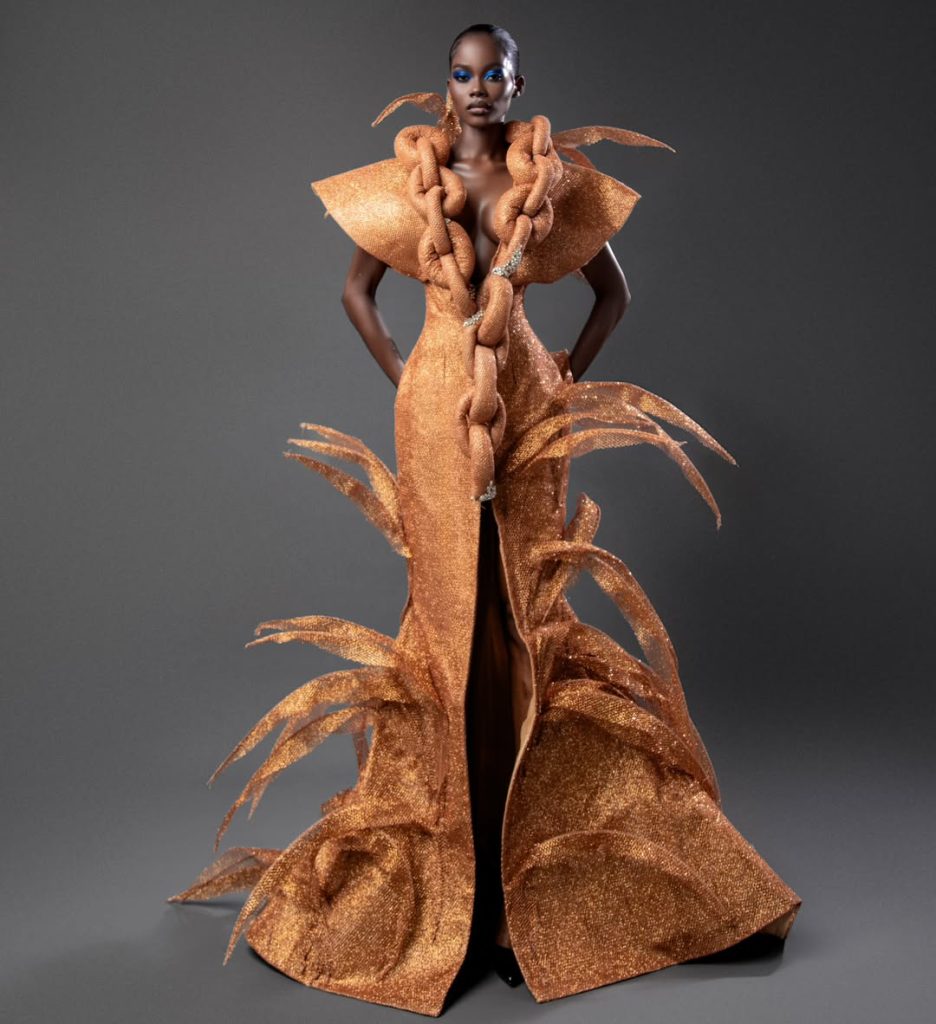
The second look amplifies the volume to operatic proportions. Here, the shoulders become the stage—massive, wing-like constructions in copper-toned mesh that recall both Alexander McQueen’s avian obsessions and the ceremonial costumes of Nigerian royal courts. The bodice, a plunging column of the same metallic weave, is interrupted by crystal embellishments that catch light like water droplets on feathers. The skirt erupts into asymmetrical panels, some rigid as bark, others soft as down, creating a textural conversation between protection and vulnerability. The model stands with hands on hips, and the garment responds by expanding outward, claiming territory, refusing the narrow verticality that conventional eveningwear demands.
By the third look, Dhurm Franklyn introduces chromatic disruption. A strapless peplum in gold—shorter, more architectural than its predecessor—sits atop a floor-length velvet column. The innovation arrives at the neckline: a vertical structure of gold that suggests both phoenix plumage and Art Deco sunbursts, rising toward the collarbone like a creature preparing for ascent. The back reveals its secret—a tail of gold forms descending the spine, vertebrae rendered in couture, transforming the wearer into something between woman and wondrous beast.
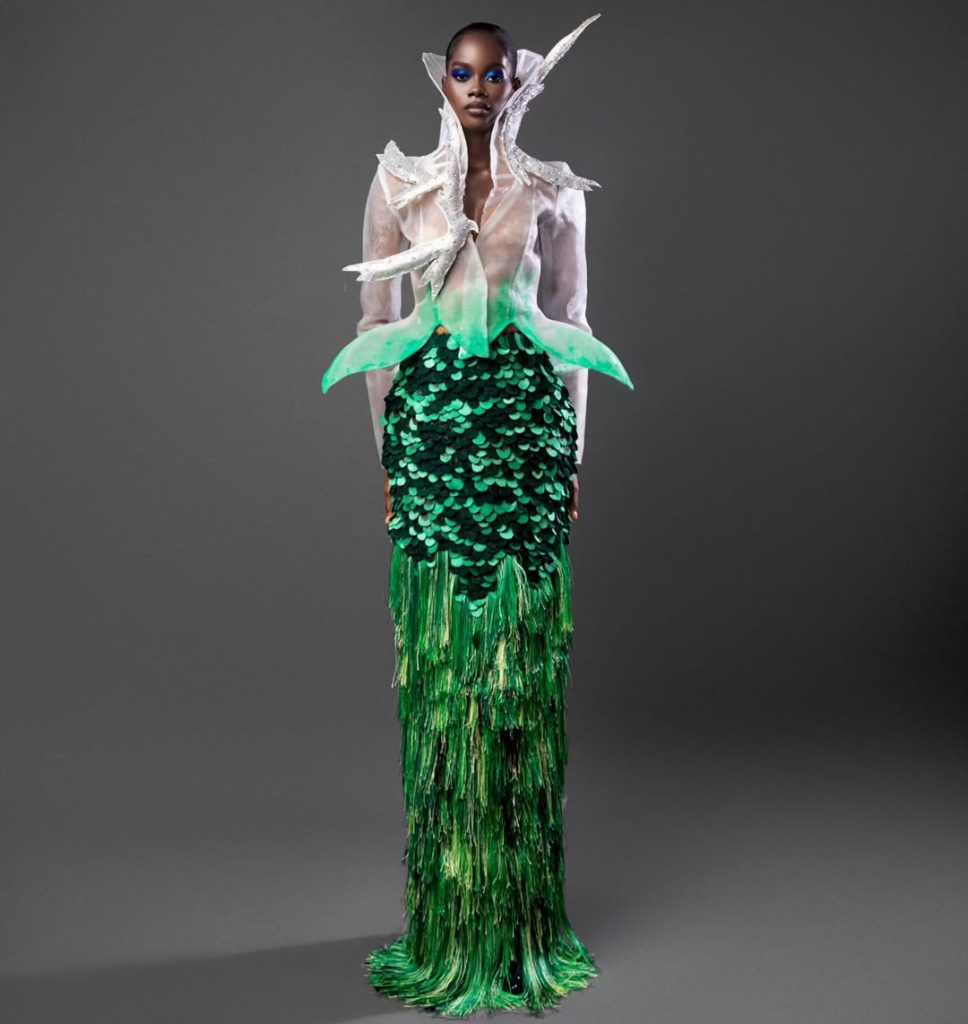
The fourth look ventures into translucency and transformation. An organza blouse in palest mint, its collar exploding into crystalline shards that frame the face like a halo of ice, gives way to a skirt of emerald sequins that shift from fish-scale density at the hip to fringed liquidity at the floor. The silhouette suggests mermaid mythology filtered through Nigerian coastal folklore, the upper body ethereal and vulnerable, the lower body armored and aquatic. The color progression—from mint to deep forest green—creates an ombre effect that implies the garment is still wet, still becoming, still in the process of evolution.
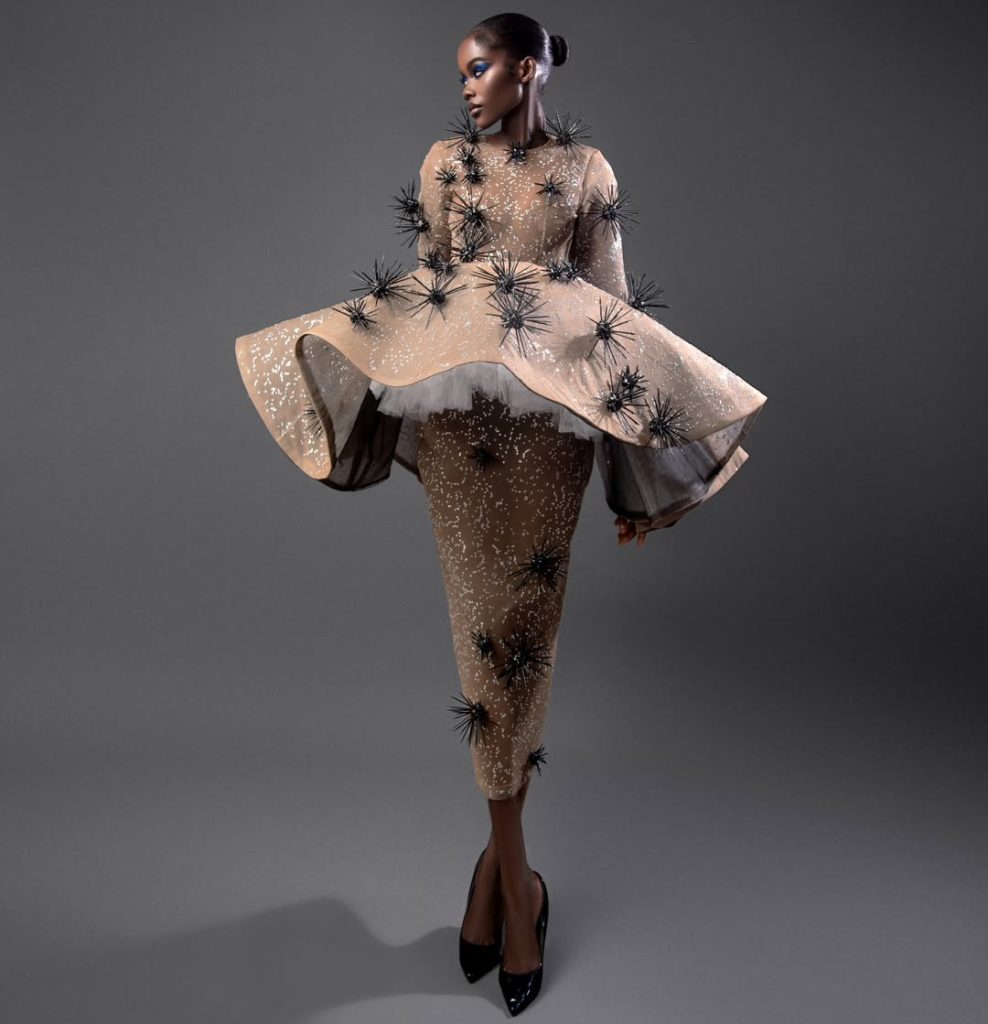
Then arrives the look that will dominate editorial coverage: a nude mesh column embroidered with white crystals and punctuated by black spiky forms that suggest sea urchins, starbursts, or the defensive mechanisms of threatened beauty. The sleeves billow into exaggerated bells, creating a silhouette that references both 1830s romanticism and contemporary performance art. A white tulle underskirt peeks beneath the hem, offering the only softness in a garment that otherwise reads as weaponized elegance. This is couture as porcupine strategy—allure through danger, attraction through the promise of pain.
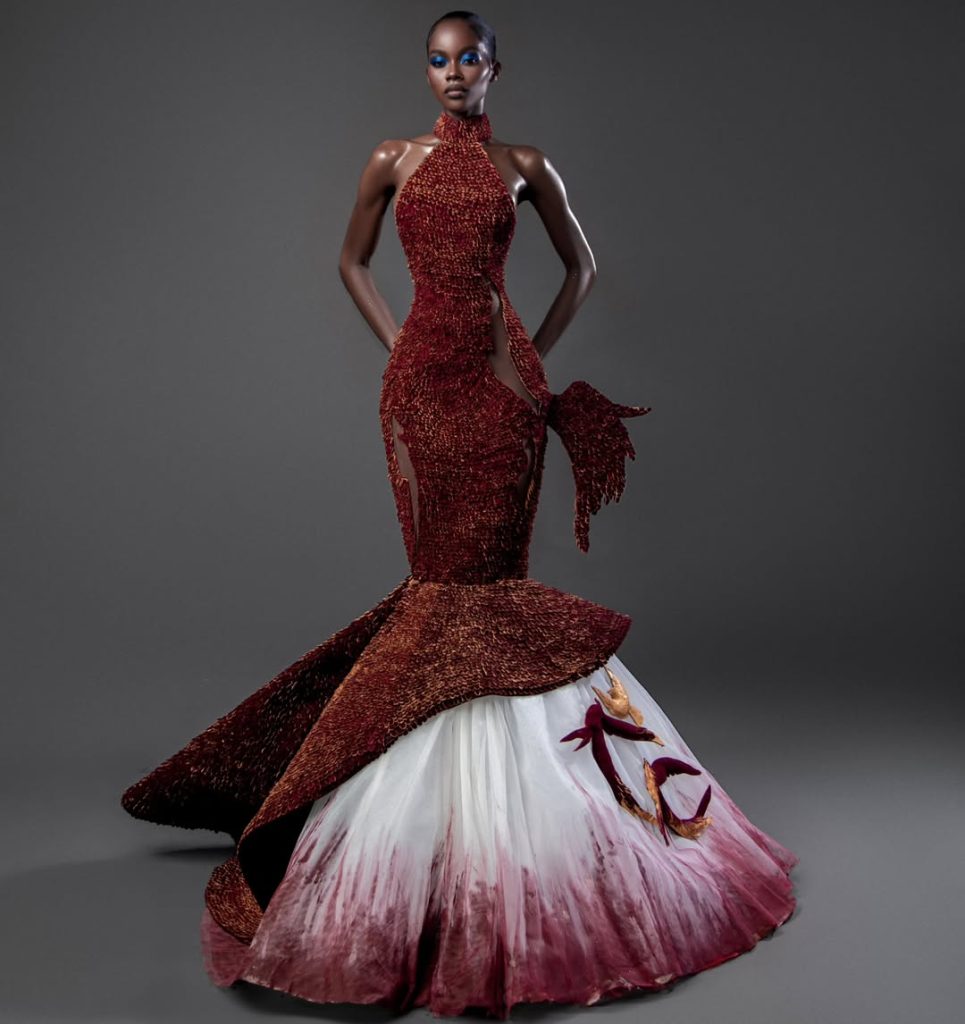
The sixth look returns to the collection’s avian obsession with dramatic narrative intent. A halter neckline in deep burgundy beading gives way to a mermaid skirt that flares into architectural volume, its outer layer a rigid shell that parts to reveal an inner world of white tulle painted with crimson at the hem—suggesting either sunset, blood, or the natural gradient of feathers. A single gloved hand emerges from the beaded bodice, the appendage becoming sculptural element, the human form surrendering to the garment’s mythology.
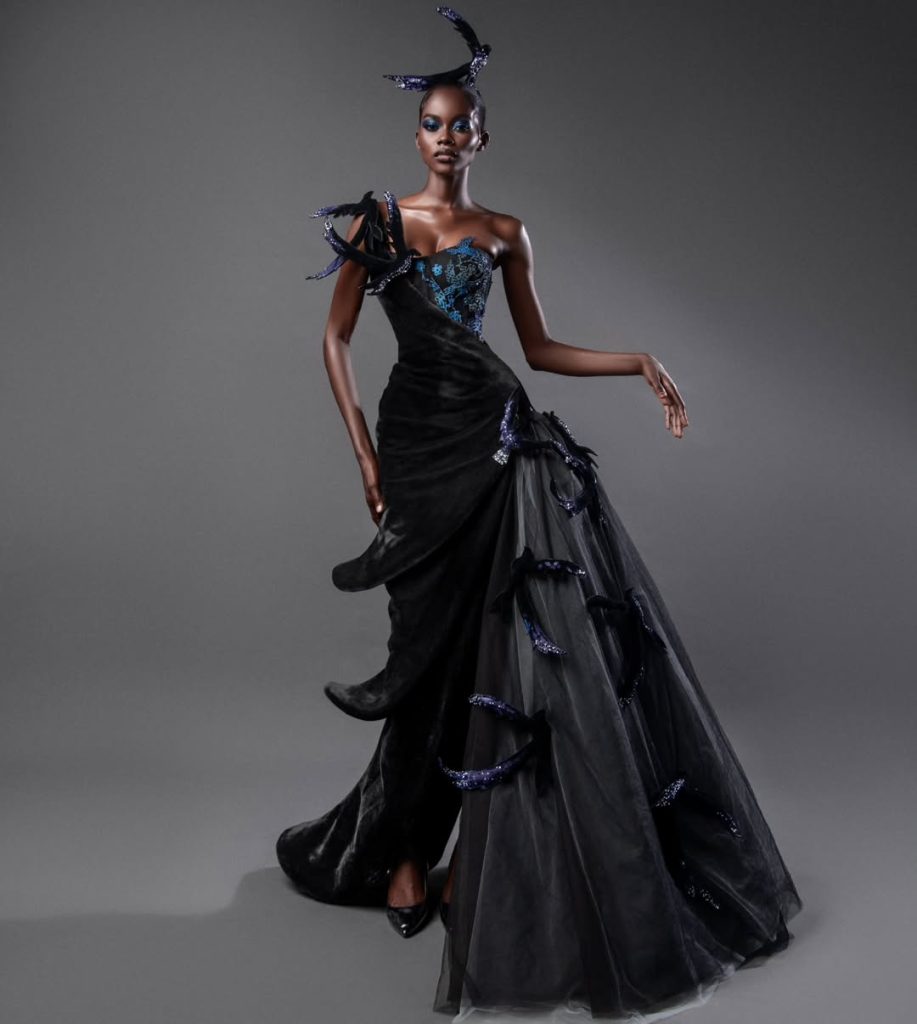
Then: midnight and metamorphosis. A strapless black velvet gown, its bodice embroidered with midnight-blue crystals in patterns that suggest both constellation maps and the microscopic structure of butterfly wings, erupts at the shoulders into crescent forms that spiral upward like horns, like tusks, like the crescents of a new moon. The skirt panels part to reveal tulle, the black becoming transparent, the solid becoming void, the garment suggesting that darkness itself is merely the absence of light rather than the presence of nothingness.
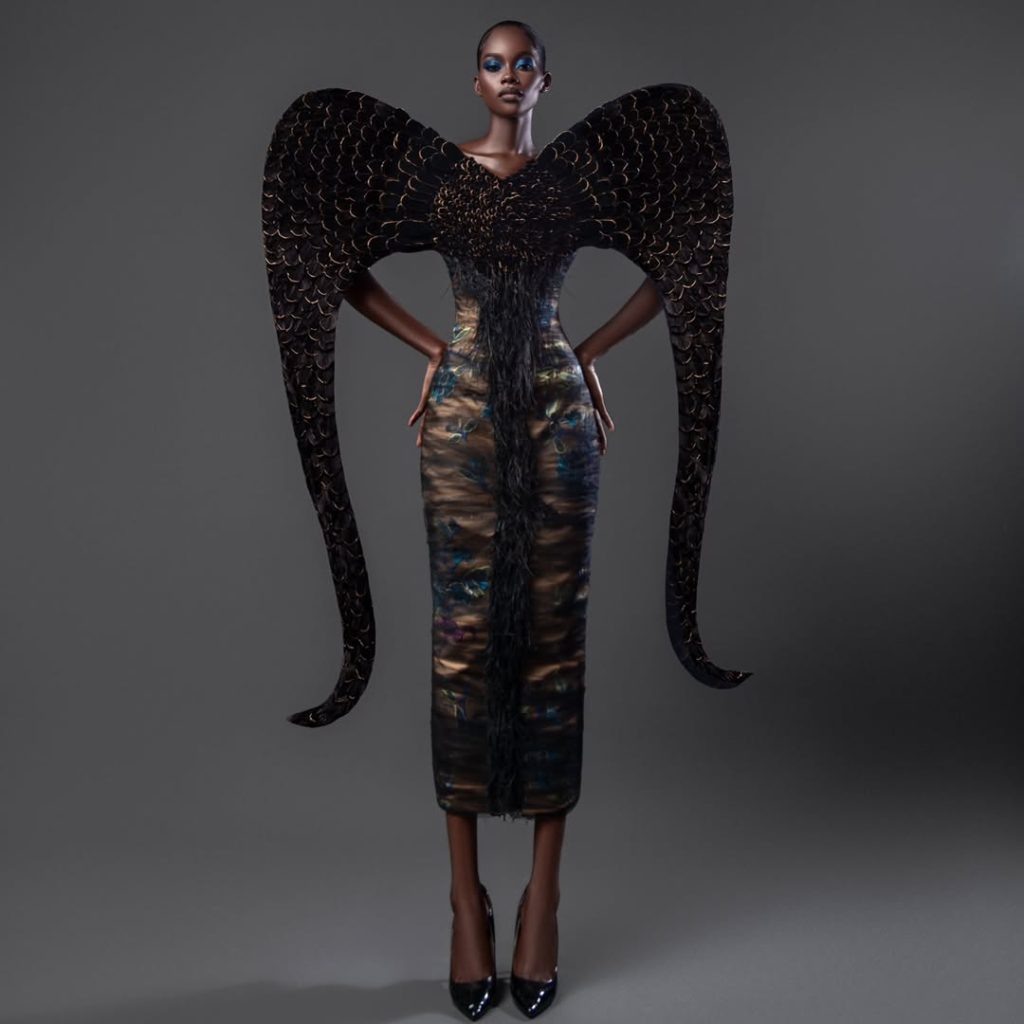
The eighth look achieves total structural audacity. A sheath dress in iridescent brocade—copper, teal, gold shifting with each movement—is overtaken by shoulder constructions that extend horizontally into massive, scaled wings, their surfaces catching light like beetle carapaces. A vertical line of black fringe descends the center, suggesting spine, suggesting zipper, suggesting the seam where two realities meet. The model’s hands rest on her hips, and the wings respond by expanding further, creating a silhouette that measures presence in feet rather than inches, that transforms doorway into destination.
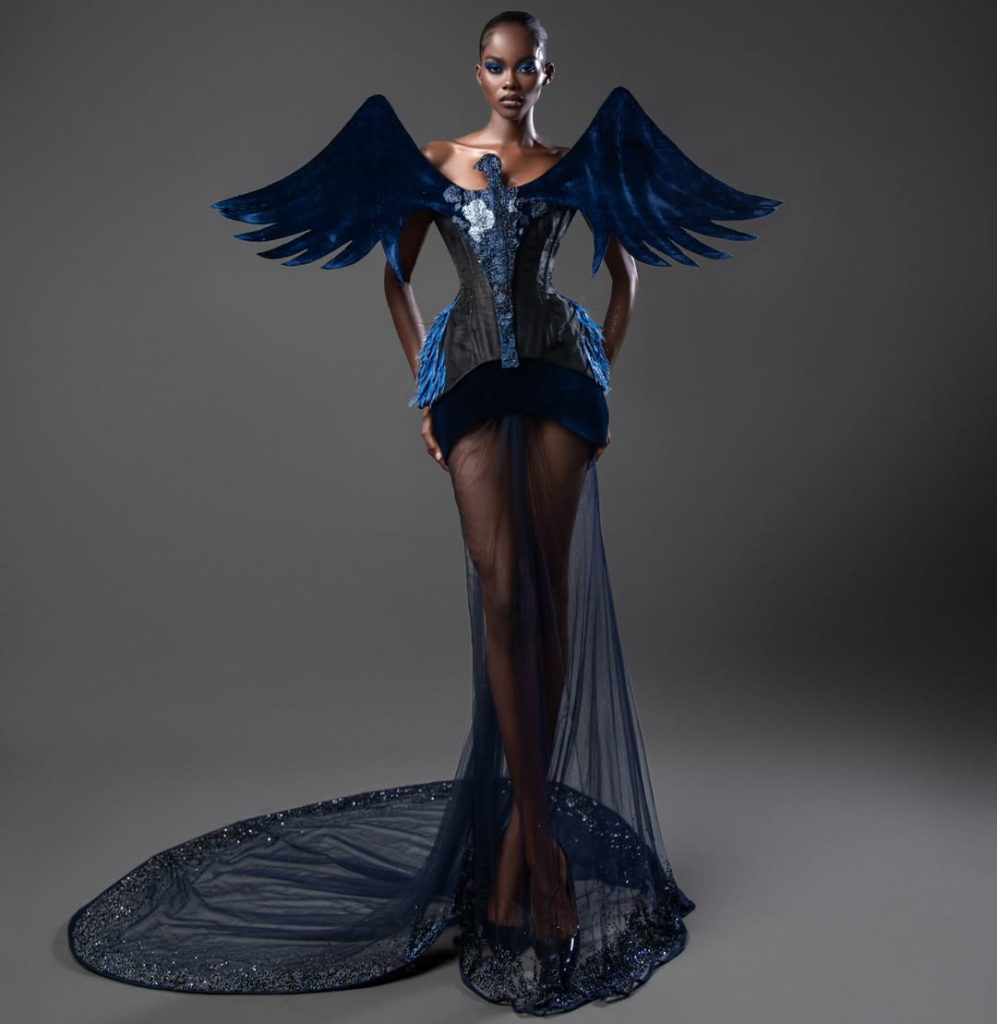
The ninth look introduces velocity and flight. A corseted bodice in slate and blue, its surface embroidered with crystalline patterns that suggest both ice formation and digital glitch, supports shoulder constructions that rise like wings in mid-flap—vertical, alert, ready for departure. The skirt, a column of sheer black tulle over velvet shorts, extends into a train that pools like spilled ink, its edge beaded with the same crystalline density as the bodice. This is couture for the moment before takeoff, the garment capturing the tension between earth and air, between the desire to remain and the compulsion to depart.
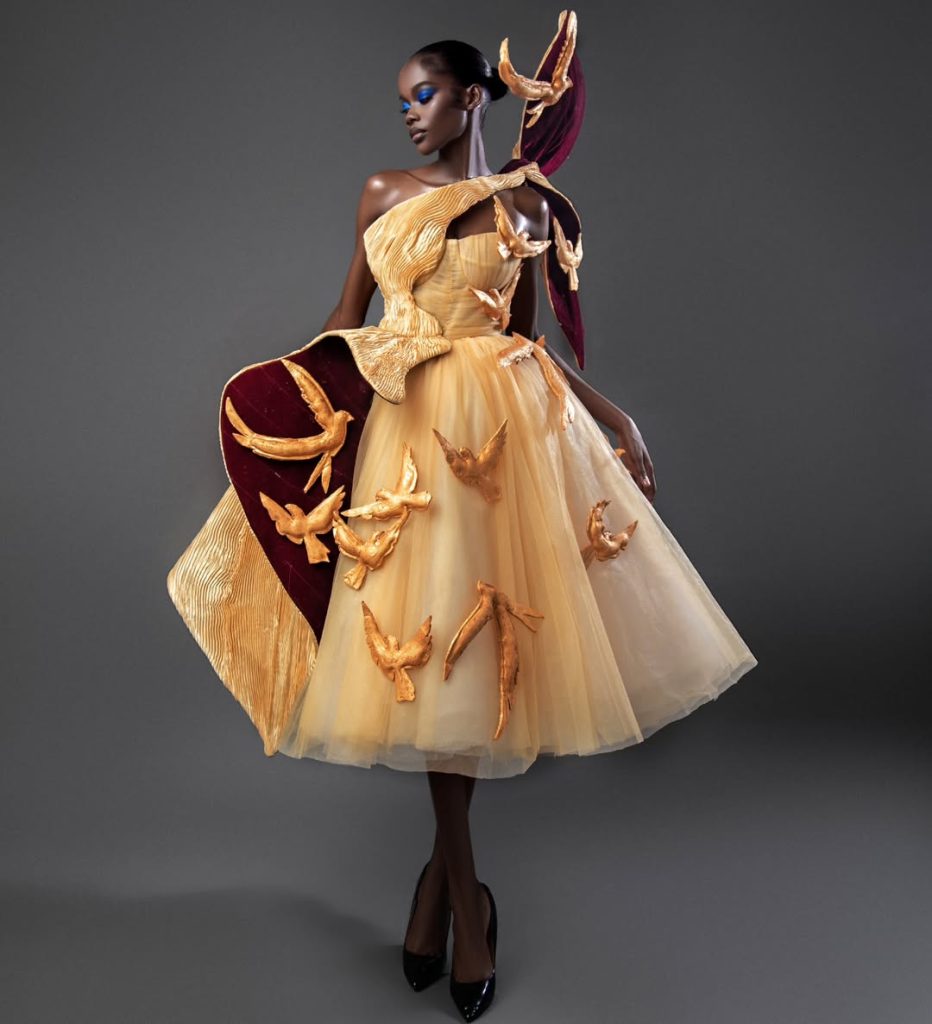
The tenth look offers sunlight and sanctuary. A strapless bodice in textured gold, its surface suggesting both bark and brocade, gives way to a skirt of pale tulle embroidered with golden birds in three-dimensional flight—some ascending, some descending, all captured in moments of arrested motion. A massive structural element in burgundy velvet and gold extends from one shoulder, suggesting both cape and cocoon, protection and display. The birds appear to have escaped from this structure, the garment telling a story of liberation and return, of leaving and coming back transformed.
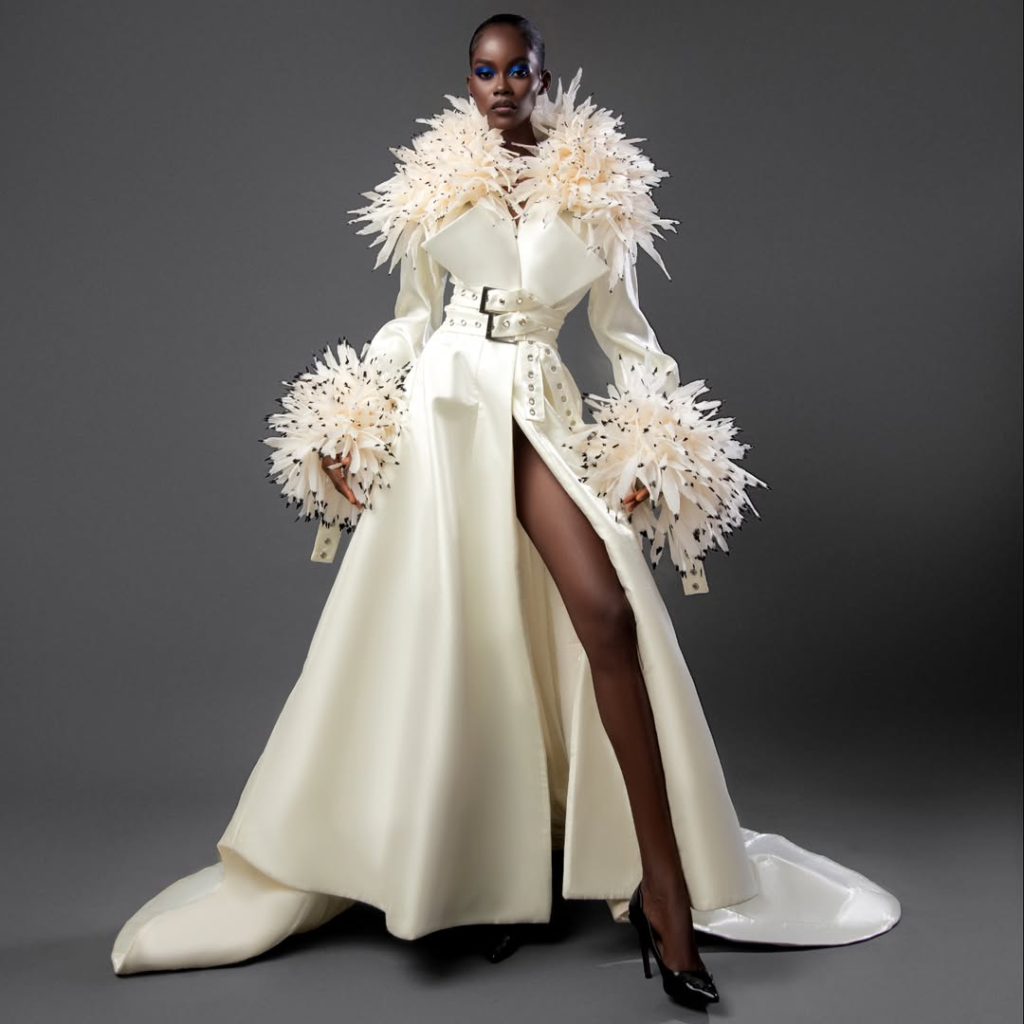
The penultimate look presents winter and authority. An ivory coat dress in heavy satin, its collar and cuffs exploding into white feathered forms tipped with black, closes with military precision at the waist. The skirt, slit to the hip, reveals leg and stocking and stiletto, the eroticism emerging not from exposure but from the contrast between the garment’s severity and its plumage. The feathers suggest both luxury and violence—the materials of flight repurposed for decoration, the natural world domesticated into couture.
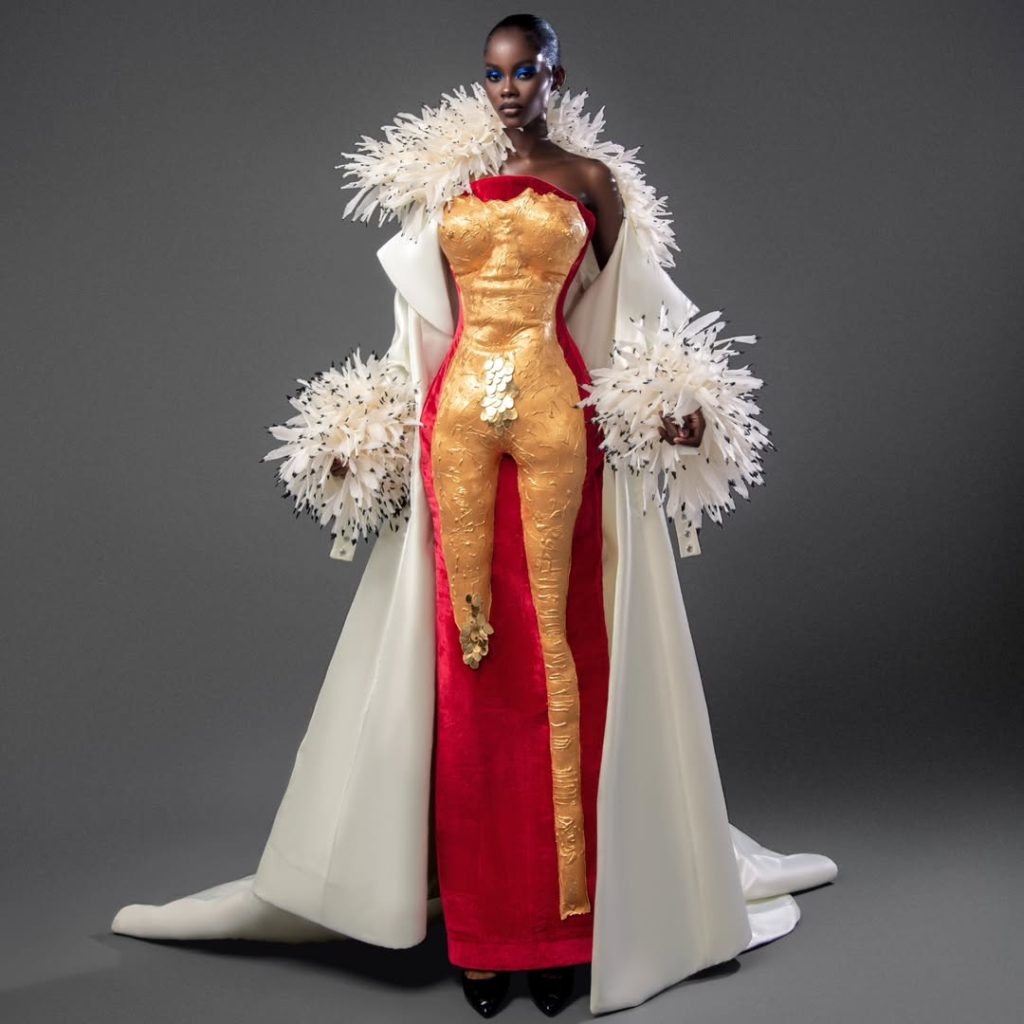
The final look achieves synthesis and apotheosis. A column of crimson velvet, its surface interrupted by a golden form that suggests both anatomical study and religious iconography—musculature rendered in metallic thread, organs replaced by floral embellishments—is framed by a coat of ivory satin whose collar and cuffs explode into the same white-and-black feathers that marked the previous look. The golden form extends from throat to thigh, transforming the body into relic, into reliquary, into the container for something precious and preserved. The model holds feathered spheres in each hand, as if she has plucked them from her own garment, as if the collection’s central metaphor has become literal: we are all melodies waiting to be released, feathers waiting for wind.
The Craft and the Culture
What distinguishes Dhurm Franklyn’s work from mere spectacle is the archaeology of technique visible in every seam. The corsetry—always the foundation of these looks—references both the structural engineering of nineteenth-century French ateliers and the body modification traditions of various African cultures. The beading, dense and dimensional, suggests the labor intensity of haute couture while simultaneously evoking the beaded crowns of Yoruba royalty. The feathers, synthetic and sculptural rather than natural, acknowledge the ethical imperatives of contemporary luxury while pursuing the aesthetic impact that only avian forms can provide.
The collection’s title, Melodies in a Feather, reveals itself as more than poetic flourish. Each look sounds as much as it appears—the metallic elements catching light like cymbal crashes, the fringes whispering like brushes on snare, the structured silences of velvet suggesting the rests between notes. Dhurm Franklyn has composed not a wardrobe but a symphony in twelve movements, each garment a measure in a larger score that the wearer completes through performance.
In the context of African fashion’s global ascendance, this collection arrives as declaration rather than request. It does not ask for inclusion in the couture calendar; it demonstrates that the calendar has been incomplete without it. The references are pan-African and universal simultaneously—Nigerian royal traditions, Japanese origami, Victorian mourning, contemporary bio-art—all filtered through a sensibility that understands excess not as vulgarity but as necessary amplification.
The model who inhabits these garments—her skin a deep brown that the golds and ivories illuminate rather than contrast, her posture always regal, her gaze always direct—becomes the collection’s final material. She is not mannequin but medium, the vessel through which Dhurm Franklyn’s melodies achieve their frequency.
As the fashion industry continues its slow, necessary diversification, Weiz Dhurm Franklyn stands as evidence that the future of couture will not be merely more inclusive but more imaginative, more technically ambitious, more willing to treat the body as architecture and clothing as art. Melodies in a Feather does not predict that future; it inhabits it, fully formed, fully feathered, fully prepared for flight.
SEE THE COLLECTION