Few accessories possess the power to transform an entrance quite like a stiletto sandal. Equal parts architecture and adornment, its slender straps frame the foot with sculptural precision, while its distinctive rhythm announces confidence long before a word is spoken. As the silhouette continues its reign this season, Frances Theodore emerges as one of its most convincing ambassadors, wearing the trend not as a passing obsession but as a natural extension of her style vocabulary.
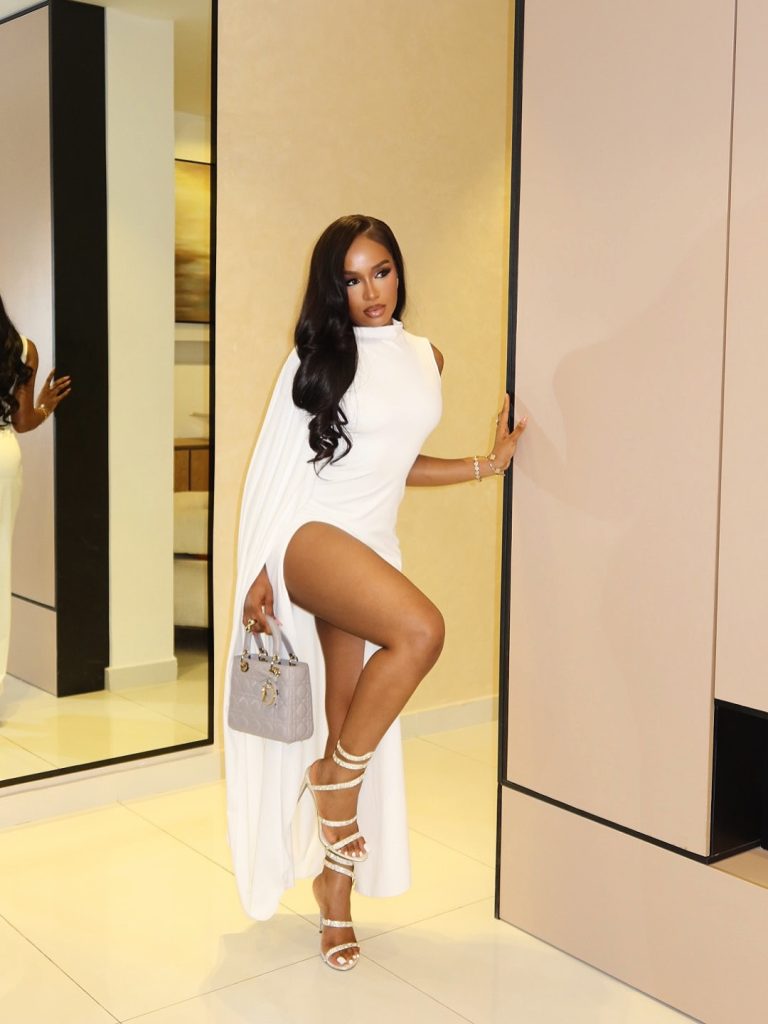
The Nigerian style star and media personality has delivered a triptych of looks that function as a masterclass in the art of the statement sandal, each one escalating in opulence while maintaining a through-line of unapologetic glamour. Consider the first frame: Theodore poses in a high-neck, sleeveless white gown with a thigh-high slit that reveals legs extending indefinitely, anchored by white pearl-studded strappy sandals—the straps delicate as dental floss, the pearls arranged with the irregularity of something found rather than manufactured. The bag is Dior’s Lady Dior in soft grey, its cannage quilting a quiet counterpoint to the sandal’s exuberance. The overall effect is bridal without the innocence, virginal without the naivety—a woman who has chosen white not because she is unmarked, but because she has earned the right to wear whatever colour she pleases.
The second look commits fully to chromatic drama. Theodore stands in a white strapless mini dress with a cascading train, the silhouette already theatrical, but it is the footwear that arrests the eye: red crystal-embellished stiletto sandals, their straps winding up the ankle in a spiral of scarlet and sparkle, the heel itself a slender dagger of silver glitter. The shoes are René Caovilla—or if they are not, they should be, so precisely do they capture the Italian house’s ethos of footwear as objet d’art. She carries a burgundy tasseled clutch that echoes the sandal’s opulence, creating a dialogue between foot and hand that feels almost baroque in its excess. Her hair is swept into a high ponytail, the extension grazing the train’s hem, a vertical line that draws the eye from crown to heel in one continuous sweep.
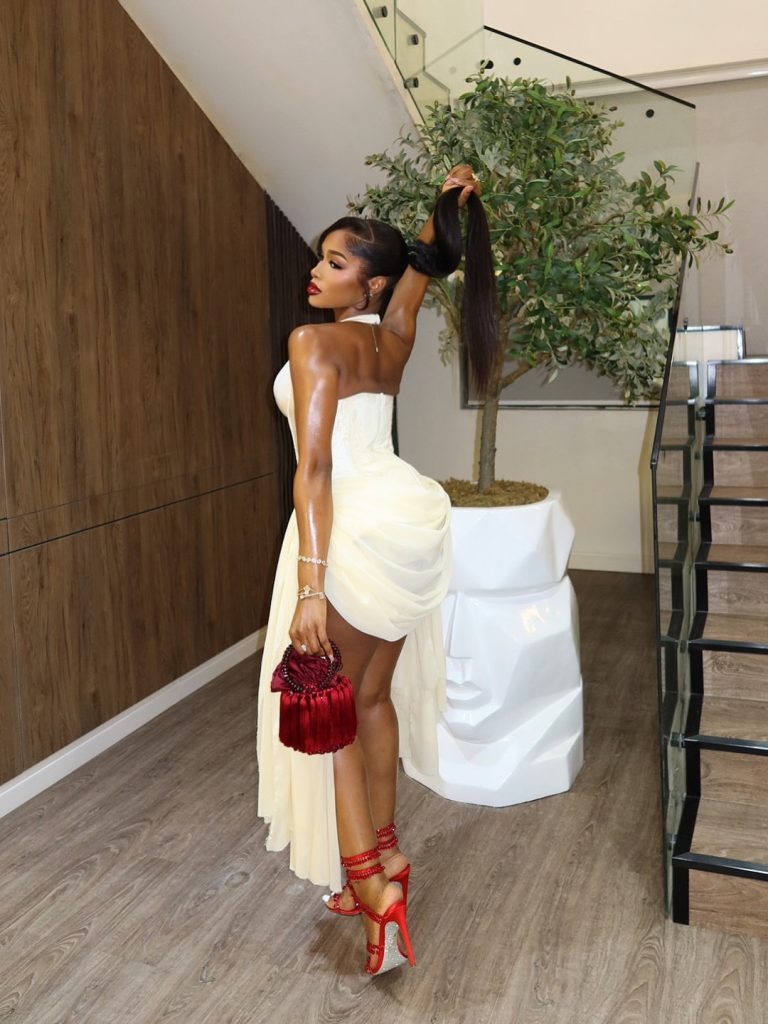
But it is the third look that most explicitly articulates the sandal’s current mood. Theodore descends a staircase in a cream corset dress with lace paneling, the bodice structured to within an inch of its life, the skirt draped and gathered into a mini silhouette that flirts with indecent. The shoes are the same red crystal sandals from the earlier look, their repetition a declaration of loyalty, their colour a defiant splash against the dress’s pallor. She holds the burgundy tassel clutch once more. The coordination is not accidental; it is a manifesto. These are not shoes you wear once and retire. These are shoes you build looks around, shoes that demand to be seen again and again until they become synonymous with your name.
What unites these moments is Theodore’s understanding of the sandal as architecture. The straps do not merely hold the foot; they reshape the leg, creating lines where there were none, drawing the eye upward in a continuous sweep from toe to hip. The heel height—always significant, never sensible—alters the posture, thrusts the pelvis forward, forces the shoulders back. These are shoes that make you stand differently, walk differently, be differently. They are the closest thing fashion has to a magic spell.
The beauty of this moment is its inclusivity. The statement sandal does not discriminate by dress size, by height, by the thickness of an ankle. It asks only for confidence and a willingness to be looked at. Theodore, in her crystal-encased exuberance, represents the apotheosis of this philosophy: the foot as canvas, the shoe as declaration, the woman as the entire conversation.
As the season progresses and the red carpets unfurl, expect to see more of this. The sandal has returned, and Frances Theodore has already claimed it as her signature.