The Nigerian pop sensation proves that beauty’s new frontier lives at the intersection of metallic innovation and unapologetic attitude
When Ayra Starr stepped into the Vanity Fair after-party atmosphere, she brought with her a beauty philosophy that rejects subtlety in favor of spectacle, that understands the after-party is not the main event’s quiet cousin but its amplified reflection. The look—crafted by a team clearly fluent in the language of contemporary glamour using Danessa Myricks Beauty—operates as a masterclass in coordinated metallics, where eyes, skin, and nails converse in tones of chrome, rose, and liquid light.
The eyes arrive as architectural statement, rendered in the Freedom Eyeshadow Palette’s cooler registers—silver, slate, and that particular gunmetal that suggests both armor and invitation. The application, built upon the Yummy Skin Blurring Balm Powder’s perfected canvas, achieves a molten quality that catches flash photography with predatory precision. This is not the soft wash of daytime; this is definition as declaration, a wing that extends toward the temple with the certainty of blueprint, a crease carved deep enough to cast its own shadow. The lashes, stacked to densities that verge on the theatrical, complete the optical illusion—the gaze enlarged, intensified, rendered unforgettable across crowded rooms.
The skin tells its own story of barrier and breakthrough. The 10/10 Barrier Boost Serum and Moisture Repair Balm create a foundation of apparent health—skin that suggests it has never known dehydration, never suffered the indignities of long-haul flights and press schedules. Upon this, the Blurring Balm Powder Flushed in “It Girl” deposits a pink that reads as flush rather than application, as if the cheek has just received compliment or caught the fever of excitement. The Liquid Blurring Balm Setting Spray seals the performance, transforming makeup into second skin, into armor that will survive the night’s heat and embraces and inevitable perspiration.
But the nails—those ten extensions of intention that have become the signature flourish of a generation’s beauty philosophy—demand particular meditation. Here they appear in chromium and crimson, a color story that shifts between silvered mirror and deep burgundy depending on the angle of light and the gesture of the hand. The length is significant—not merely decorative but declarative, extending the finger’s line, transforming every movement into performance. When Ayra brings her hand to her lips, the nail becomes punctuation mark, the metallic surface catching ambient light, the crimson underside revealed like a secret or a threat. These are nails designed for visibility in darkness, for catching the flash of cameras, for completing the silhouette when the hand rises to adjust an earring or brush away hair or gesture while speaking.
The lips, painted in a glossy pink that echoes the blush’s warmth, refuse the current obsession with overlined volume in favor of something more sophisticated—definition without distortion, color that suggests approachability while the eyes and nails maintain their distance. The finish is wet, reflective, creating a third point of light-catching surface in the composition’s geometry.
The hair—sculpted upward and outward, a cloud of dark texture held in place by jeweled band—rejects sleekness in favor of volume as crown, the silhouette expanding to match the drama of the face. Tendrils escape at the temple, suggesting movement, suggesting that this construction is temporary, that beauty is performance rather than permanence.
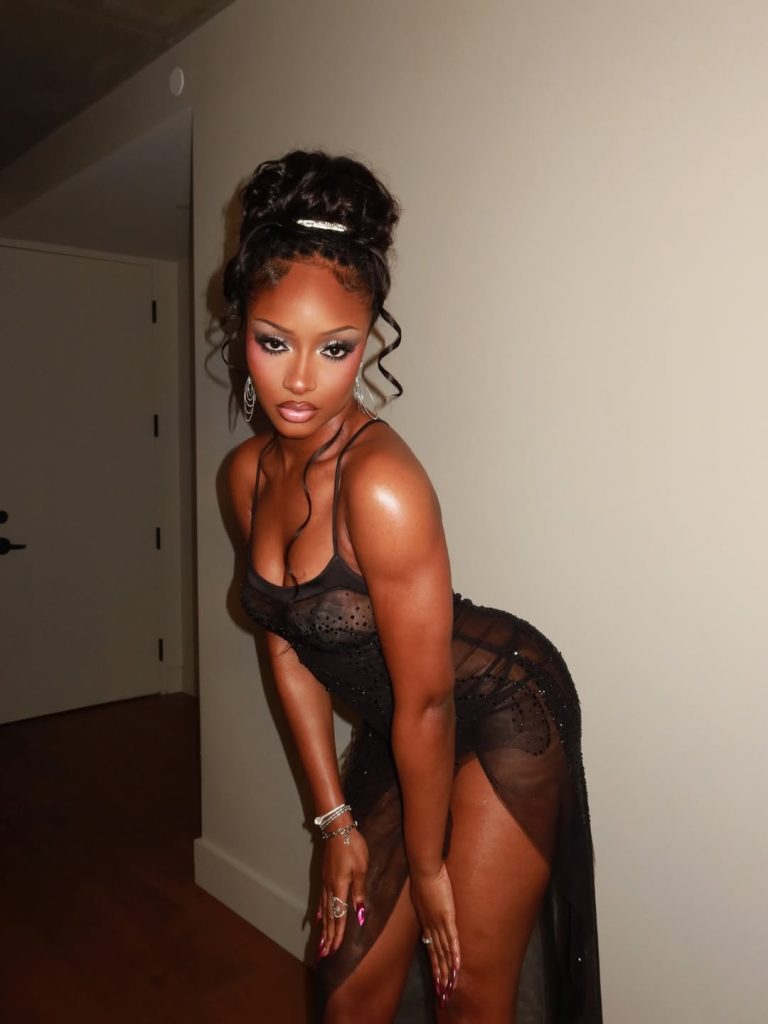
The dress—black, sheer, beaded, a second skin that reveals as much as it conceals—operates as the final element, the necessary darkness against which the chrome eyes and metallic nails achieve their full effect. The silhouette clings and releases, the beading catching light in scattered constellations, the sheer panels suggesting both vulnerability and power.
What emerges is a beauty philosophy for the post-pandemic night, a rejection of minimalism in favor of maximalism as celebration, as declaration, as refusal to be diminished. Ayra Starr understands that the after-party is where legends are cemented, where the main event’s polish gives way to something more dangerous, more memorable, more true. The chrome eyes, the sculptural nails, the cloud of hair—each element operates as signifier, as code, as invitation to look closer and discover the intelligence behind the shimmer.