Uncle Waffles does not pose; she pulses. Even in stillness, there is motion—the suggestion of BPM translated into flesh and fiber, of club culture crystallized into portraiture.
READ MORE: Fave Szn Debuts Fiery Copper Afro Hair Do
Her latest pose includes a hair commands immediate attention—not one silhouette but two, offered as options, as versions, as remixes of a single identity. In one frame, a high flipped ponytail erupts from cornrowed precision, the ends bumped upward in defiant curl, a gravity-defying arc that references both 90s R&B and futuristic sport. The braids at the scalp are mathematical, architectural, each parting a straight line drawn with intention; the flipped-out volume above is pure chaos, pure joy, pure movement frozen at its peak. In the second frame, the hair splits into twin flipped pigtails—space buns with bumped ends reimagined for an age that refuses childhood innocence, that weaponizes playfulness into power. The ends curl outward like quotation marks, like horns, like the visual representation of stereo sound.
This is hair as DJ culture—sampling, looping, transforming the familiar into the unexpected. The cornrows speak to tradition, to the labor of Black women’s hands and time; the flipped ends speak to now, to next, to the beat dropping. Waffles wears it with the ease of someone for whom hair is not maintenance but instrument, not identity but interface.
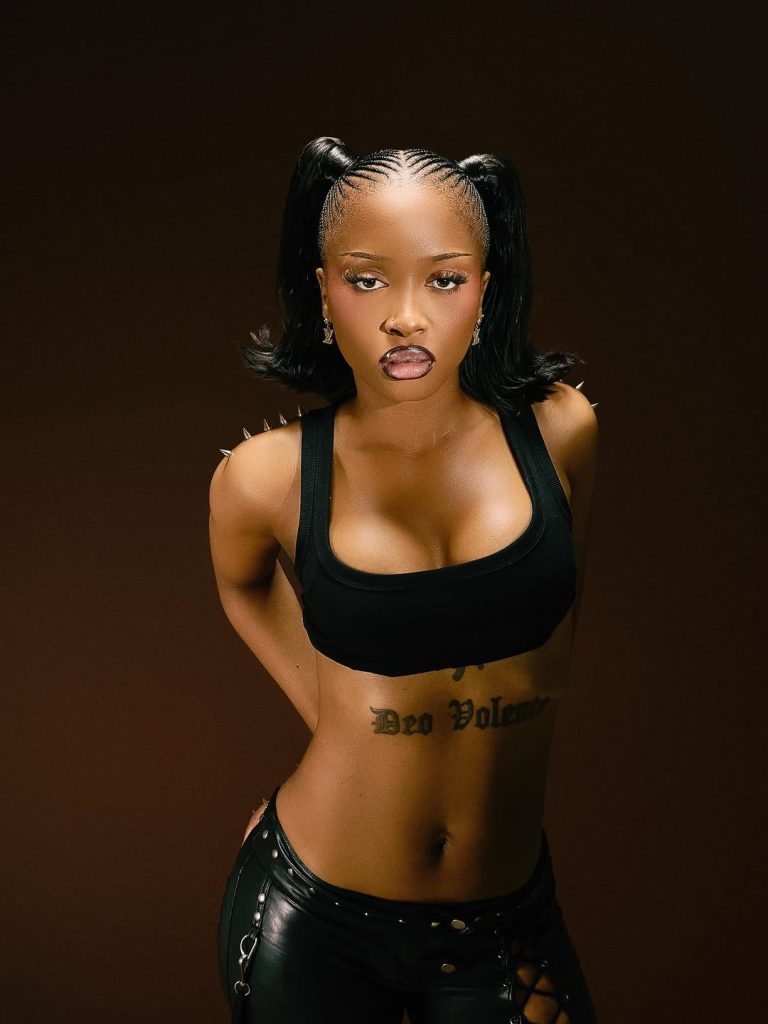
The face beneath is sculpted for drama—brows drawn with architectural precision, eyes framed in lashes that reach for something beyond the frame, lips glossed to catch light like a vinyl surface. She looks at the camera without need, without request, with the confidence of someone who knows the crowd is already hers.
The styling operates in deliberate contrast to the hair’s exuberance. A black velvet top—simple, almost severe—grounds the silhouette, allowing the flipped ponytail to be the event. But the shoulder refuses to be silent: gold spikes emerge from the fabric like armor, like warning, like the physical manifestation of a beat that cuts through the mix. In the second frame, a black sports bra does the work of athletic functionality while the shoulders carry the same defensive glamour, the same suggestion that softness and danger can coexist.
Below, leather arrives with hardware—chains, grommets, cutouts that reveal skin as strategic punctuation. The tattoo across her ribs reads “Deo Volente” in gothic script, a whisper of faith or fatalism beneath the industrial exterior. The body is toned, present, available to the gaze on her own terms.
The lighting is warm, intimate, almost amber—like the glow of a booth at 3 AM, like the color of bass through a speaker. There is no background distraction, no narrative context beyond the self. Uncle Waffles offers herself as complete statement, as entire ecosystem, as proof that the DJ has become the main event, that the one behind the decks now steps forward to be seen.