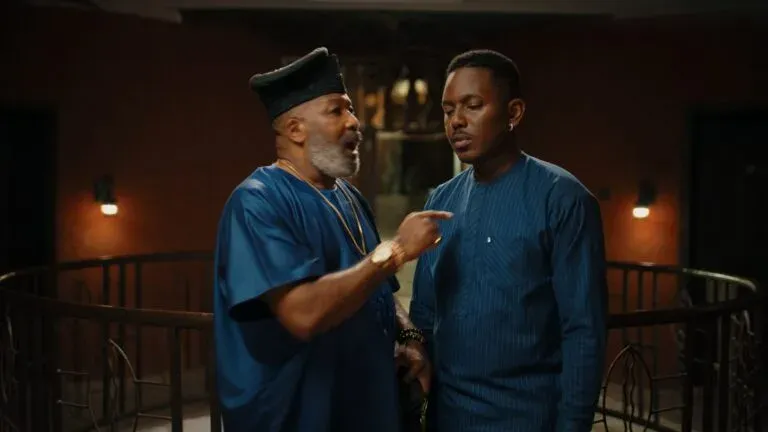
Few genres belong to Nollywood as naturally as the family dramedy—the kind where weddings become battlegrounds, secrets surface between courses, and every celebration threatens to unravel into glorious chaos. Ajosepo 2: The Gathering returns to exactly that terrain, expanding the universe of one of 2024’s biggest local box-office successes with a sequel that appears larger, louder, and even more emotionally combustible.
Two years after the original Ajosepo transformed wedding-day tension into crowd-pleasing spectacle, the sequel shifts its attention toward a new couple, Jide and Mary, played by Timini Egbuson and Bolaji Ogunmola. But if the film’s premise revolves around another wedding, the real attraction remains the same: the collision of personalities, family politics, and unresolved history that only Nigerian celebrations seem capable of producing with such operatic precision.
At the center of the sequel’s return is director Kayode Kasum, whose growing reputation as one of Nollywood’s most commercially reliable filmmakers continues to strengthen. Known for balancing broad humor with emotional familiarity, Kasum has quietly become one of the architects of contemporary mainstream Nigerian cinema, with multiple entries among the country’s highest-grossing films. His return suggests Ajosepo 2 intends not simply to replicate the original’s formula, but to sharpen it.
The cast alone reads like a cross-section of Nollywood’s current entertainment ecosystem. Alongside returning faces are notable additions, including Toyin Abraham, whose presence instantly raises the film’s comedic and dramatic stakes. She joins an ensemble that includes Mercy Aigbe, Mike Afolarin, Tomike Adeoye, Odunlade Adekola, and others whose collective chemistry thrives within stories built on conflict, comedy, and emotional excess.
One of the film’s more compelling details lies behind the scenes. The production is led by three women—Bolaji Ogunmola, Feyifunmi Oginni, and Barbara Babarinsa—a collaborative creative structure that gives the sequel both continuity and renewed perspective. Ogunmola’s dual role as producer and lead actress further positions her as one of Nollywood’s increasingly influential multi-hyphenate talents.
Visually, the film also benefits from its setting. Principal photography took place at KAP Film Village, the expansive production destination founded by Kunle Afolayan. The location has rapidly become one of Nollywood’s most aesthetically significant creative spaces, offering filmmakers the scale and immersive environment necessary for larger cinematic storytelling. For Ajosepo 2, it appears to provide the perfect backdrop for family spectacle elevated into full visual event.
The timing of the release feels strategic. While the original film dominated April 2024’s box office with over ₦257 million in earnings, the sequel arrives on May 28, 2026, entering a different release corridor and testing whether the franchise’s audience loyalty can translate into sustained cinematic momentum. Given the first film’s commercial success, expectations are understandably high.
But perhaps the real appeal of Ajosepo 2: The Gathering lies in what it represents within Nollywood’s broader evolution. Nigerian cinema is increasingly learning how to build franchises audiences emotionally invest in—not just individual hits, but recurring worlds viewers want to revisit. The Ajosepo films understand that weddings in Nigerian storytelling are never just weddings. They are pressure cookers for class tension, generational conflict, romance, performance, and public spectacle.
And if the first film proved audiences were eager for that familiar chaos, the sequel appears ready to deliver it on an even grander scale.