Fashion’s most enduring comebacks rarely announce themselves loudly. Instead, they slip quietly back into wardrobes until suddenly they feel inevitable. The ballet flat revival belongs firmly in that category, and Frances Theodore has just delivered one of its clearest modern interpretations. In an era dominated for years by oversized sneakers and aggressively sculptural footwear, her latest look makes a compelling argument for softness, restraint, and the understated power of a beautifully constructed flat.
Inside a refined boutique framed by curved wooden shelving and marble surfaces, Theodore sits with the kind of effortless composure that makes simplicity appear impossibly luxurious. The eye lands almost immediately on the shoes: black mesh ballet flats delicate enough to reveal the contours of the foot beneath them, yet structured enough to maintain an elegant silhouette. They do not overwhelm the outfit. They sharpen it. Quietly sensual, impossibly light, they embody the exact mood fashion is gravitating toward right now—less spectacle, more precision.
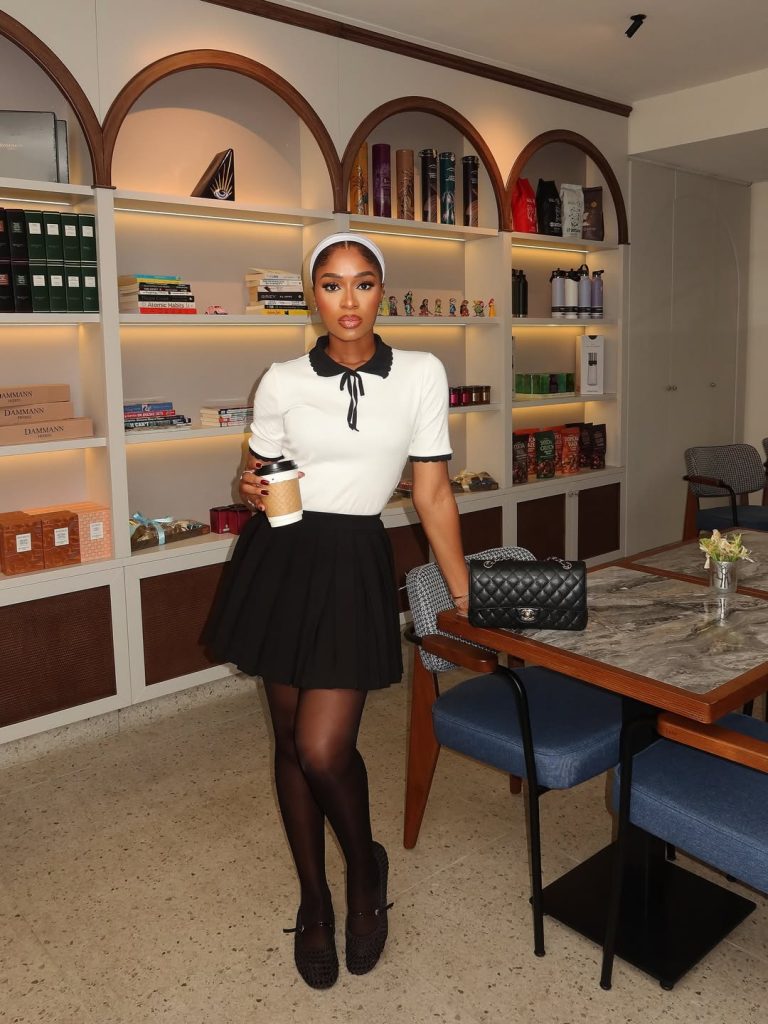
The mesh ballet flat has become one of the defining accessories of the season precisely because it understands contradiction. Transparent yet polished, delicate yet practical, nostalgic yet unmistakably modern. On Theodore, the shoe feels entirely natural, as though it has always belonged within this aesthetic vocabulary of monochrome refinement and understated femininity.
The styling deepens that conversation. Sheer black tights extend the leg into one uninterrupted line, creating a subtle interplay between opacity and transparency. The effect recalls the classic ballet-flat formula, but with greater intention and sophistication. Instead of leaning into sweetness alone, the look balances innocence with control.
A white knit top with scalloped black trim and a tiny bow introduces a note of polished femininity, while the sharply pleated black mini skirt anchors the outfit with structure. Every proportion feels meticulously considered: softness against sharpness, modesty against brevity, texture against restraint. A structured white headband completes the composition with a touch of retro elegance, evoking old cinematic glamour reframed for a digital generation.
Accessories remain disciplined. A quilted black handbag with gold hardware rests nearby like punctuation rather than centerpiece. Delicate jewelry glimmers subtly at the wrist and fingers, never disrupting the monochrome harmony. Even the deep burgundy manicure feels intentional—the single saturated interruption in an otherwise restrained palette, glimpsed occasionally through the sheer mesh of the flats.
What makes the moment resonate is its understanding of where fashion is moving. After seasons dominated by excess, the return of the ballet flat signals a collective craving for ease, intimacy, and wearability. The modern version is less prim than its predecessors, stripped of overt sweetness and rebuilt with sharper styling instincts. Theodore captures this evolution instinctively. Her interpretation feels aspirational without becoming inaccessible, elegant without appearing overworked.
As a digital creator whose personal style thrives on making everyday dressing feel cinematic, Frances Theodore understands that the most successful trends are the ones that integrate seamlessly into real life. The mesh ballet flat succeeds not because it demands attention, but because it moves effortlessly through every kind of day—boutique afternoons, airport corridors, dinner reservations, errands disguised as style moments.
And perhaps that is the true appeal of the ballet flat revival: fashion rediscovering the beauty of subtlety. In Theodore’s world, elegance does not need to shout to be remembered.