Ashley Okoli sits enthroned against a riot of emerald, saffron, and imperial purple, and immediately the eye travels upward—to those twin sculptural horns rising from her crown in perfect symmetry. They arc like crescent moons, like antennae tuned to frequencies beyond our hearing, referencing Fulani braiding traditions and high-fashion avant-garde in a single breath. This is hair as architecture, as crown, as site-specific installation. She does not style it; she commissions it, lacquered and gravity-defying, a silhouette that announces itself before she speaks.
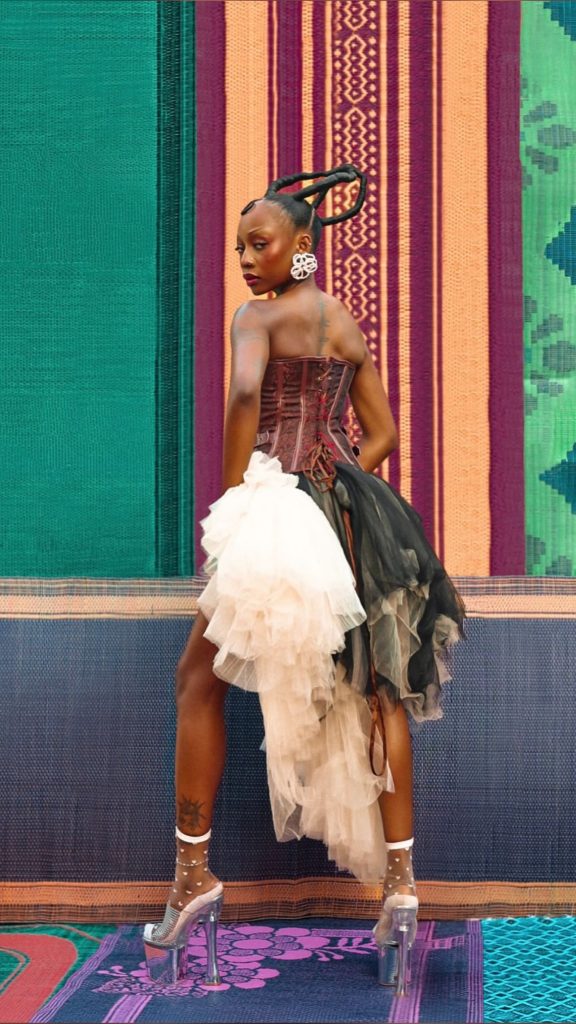
The body beneath is contained within burgundy leather—oxblood, wine, dried rose—a corset that cinches with the authority of historical undergarments yet carries the swagger of contemporary fetish wear. Buckles catch light. Boning creates structure. It demands perfect posture, perfect presence, and Ash OK delivers both without apology. The strapless cut exposes shoulders that bear the weight of this entire construction with regal indifference.
Below, the tulle erupts—not the demure confection of a ballerina, but romanticism with teeth. Layers of ivory, blush, and shadow cascade in deliberate disarray, lifting at the front to reveal a tattooed leg sheathed in sheer stockings dotted with pearl embellishments, trailing behind in theatrical excess. The skirt has its own agenda, its own relationship to gravity and air, moving like it remembers being smoke in another life.
Her feet, encased in crystalline platforms with transparent heels, elevate her into the superhuman—architectural yet ethereal, creating the illusion of walking on light. Delicate ankle straps anchor the fantasy to flesh, reminding us that this vision requires a human foundation. The pearls scattered across her stockings add a layer of vintage coquetry, the boudoir transformed into public space, the private made spectacular.
Sculptural white earrings echo the hair’s curves while softening the face. Rings stack in unapologetic accumulation, catching light, demanding attention to the gesture, to the performance of self-possession.
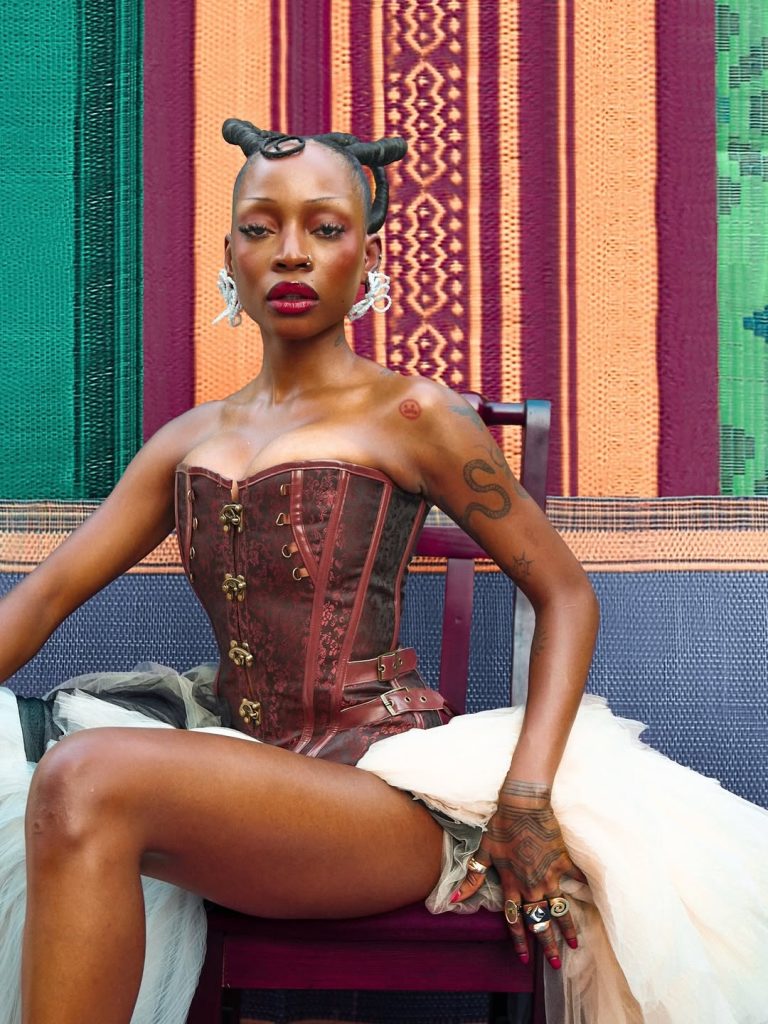
And behind her, those African textiles—rich with geometric pattern and chromatic audacity—create a world where this silhouette makes perfect sense. Ash OK does not disappear into this backdrop; she emerges from it, a figure from future folklore, from mythology not yet written. The purple chair, the layered rugs, the very texture of the walls: all conspire to frame her as artifact and prophecy simultaneously.
This is fashion as cultural synthesis, as gender performance, as sculptural practice. Ash OK occupies the tension between the corseted heroines of centuries past and the boundless possibilities of the present, between tradition and transgression, between containment and flight.
The message arrives without words: Tradition is not a cage. It is a foundation. And from it, we build our own monuments.