There is a particular alchemy to the early 2000s aesthetic that refuses to be archived. It keeps returning, not as nostalgia, but as prophecy—a vision of the future we once imagined, now filtered through the lens of 2024 sophistication. Spirine Chevy captures that temporal collision perfectly: the past, present, and a speculative tomorrow, all stitched together with industrial hardware and clear acrylic.
Let us begin with the hair—arguably the protagonist of this entire tableau. Chevy’s blonde and black braided extensions cascade in deliberate chaos, a rejection of the sleek, ironed-flat aesthetic that dominated the original Y2K era. This is post-Y2K hair: textured, voluminous, unapologetically artificial in its construction yet organic in its movement. The two-tone treatment—dark roots bleeding into platinum ends—speaks to a generation that refuses singular identity. It is hair as collage, as remix, as cultural commentary.
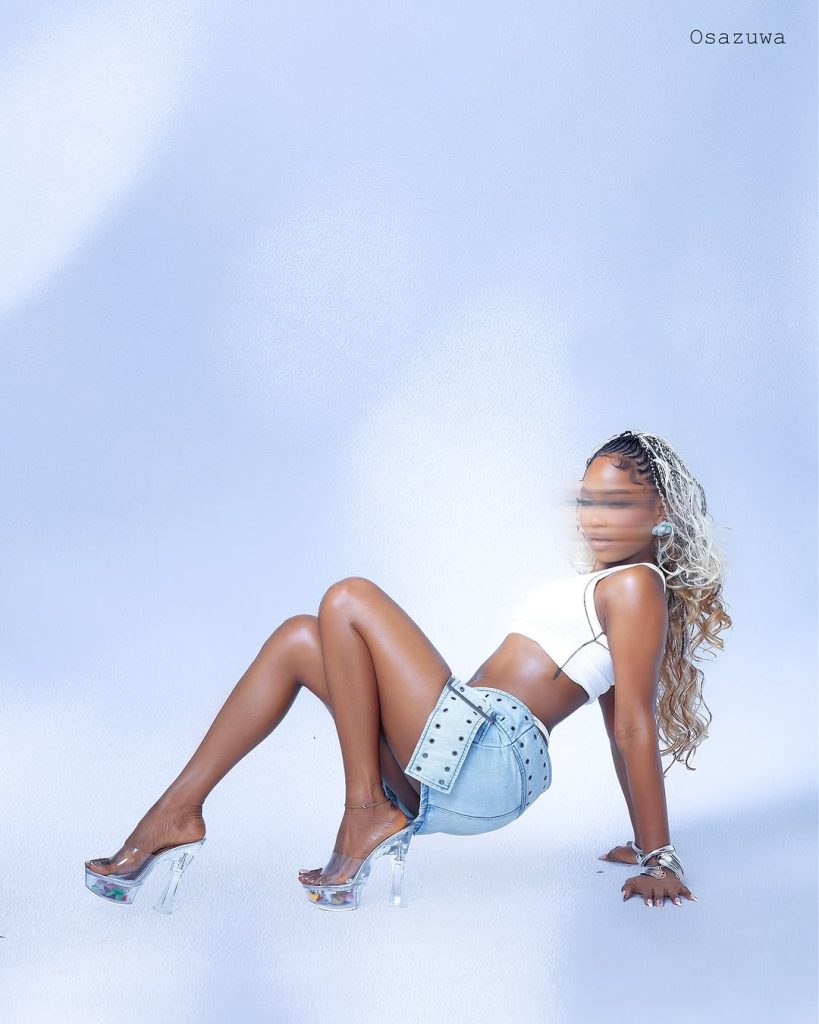
And then, the denim. But calling this a “skirt” would be an act of critical negligence. This is deconstruction as garment—a low-slung, belted contraption that hovers somewhere between mini-skirt and architectural experiment. The exposed white G-string (deliberately visible, defiantly displayed) references that controversial Alexander McQueen moment, that Sisqó video, that entire cultural conversation about visibility and agency. Yet on Chevy, it reads differently—not as exploitation, but as curated exposure. The wide belt, punctuated with industrial grommets, wraps and hangs with the casual violence of a punk reference. The denim itself is washed to that precise shade of nostalgic blue—the color of mall parking lots, of TRL, of disposable cameras.
The shoes demand their own paragraph, their own essay, perhaps their own museum retrospective. Clear acrylic platform sandals with visible floral detailing trapped within the heel—this is footwear as snow globe, as objet d’art, as architectural statement. They elevate Chevy literally and figuratively, transforming the foot into a display case. The transparency is key: nothing is hidden, everything is spectacle. These are not shoes for walking; they are shoes for posing, for the camera’s gaze, for the permanent documentation of a moment that understands itself as performance.
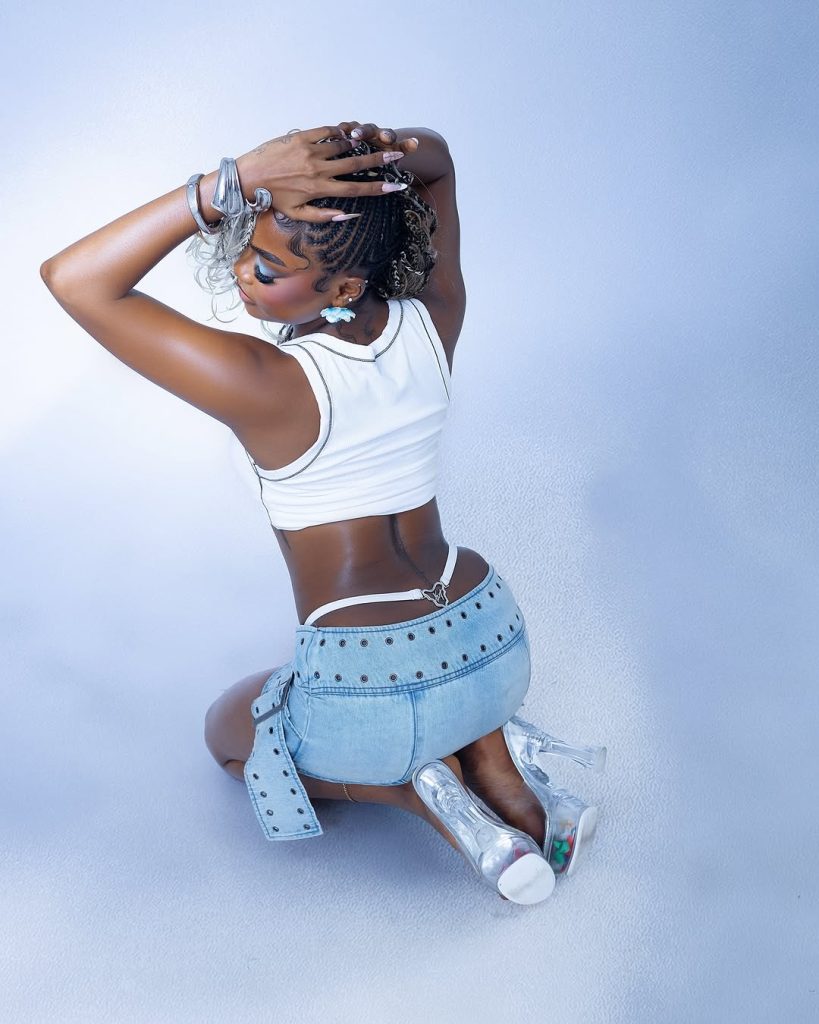
Chevy completes the narrative with surgical precision. A white ribbed crop top—minimal, almost sterile—provides the necessary counterweight to the chaos below. Silver cuff bracelets stack with the casual accumulation of wealth and taste. Turquoise earrings add that unexpected chromatic jolt, a reference to Southwestern aesthetics or perhaps just to the arbitrary logic of a mood board.
The photographic treatment deserves mention: that blown-out, high-key lighting that erases context and creates a void. Chevy floats in white space, occasionally interacting with props—a boombox, the floor, her own body—that ground her in a specific cultural moment while simultaneously liberating her from it.
This is fashion as time travel, and Spirine Chevy is our guide. The Y2K aesthetic has returned not because we miss it, but because we have finally caught up to its ambitions. We now possess the technology, the cultural vocabulary, and the critical distance to execute it properly. The early aughts dreamed of the future; we are living in it, wearing its costume, and finally understanding what it was trying to tell us all along.
The message? More is more. Visibility is power. And the platform shoe will never die.
Photographed by Osazuwa. Styling by instinct. Era: undefined.